Reena Sommer | 3 Jun 2026


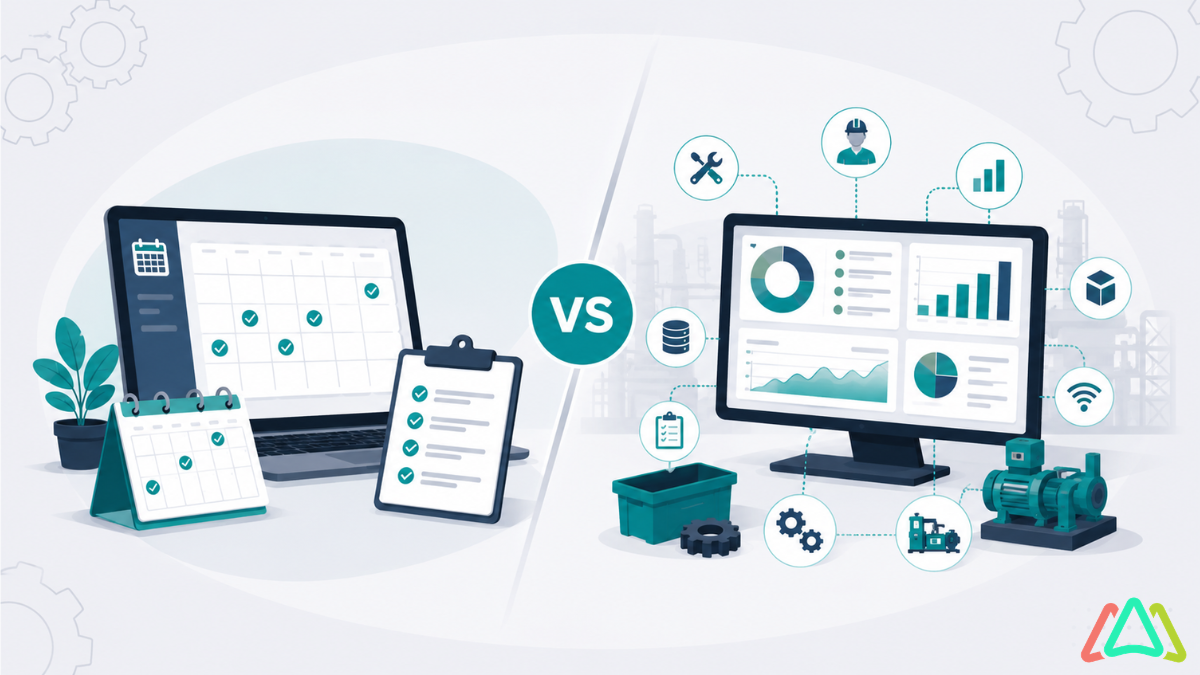
Businesses contemplating acquiring maintenance software for the first time often debate whether to choose a standalone preventive maintenance software or take the plunge and opt for a full CMMS. Their quandary is often driven by need and cost, as well as by the time and resources required to get a full system up and running.There is another reality: maintenance teams today have more software choices than ever before. Because of that, many are cautious about adding yet another CMMS, even one with a positive track record. Still, choosing between preventive maintenance software and a full CMMS is an important decision, often clouded by confusion because the two may seem similar at first glance. Although both help organize maintenance work, reduce equipment failures, and improve efficiency, the difference lies in depth, scalability, and long-term value.
With the above in mind, the question remains, which software will best suit your organization’s needs? Some organizations only need a simple way to schedule recurring maintenance tasks. Others need a complete system that manages assets, inventory, technicians, costs, reporting, and growth across multiple facilities. While purchasing software that exceeds your organization’s needs may be overkill, buying one that is insufficient can be a waste of money, time, and energy.
Here, we’ll lay out how to assess your maintenance needs as you move forward in purchasing maintenance software.
What is Standalone Preventive Maintenance Software?
Standalone preventive maintenance software is designed with one primary purpose: helping maintenance teams schedule and complete recurring maintenance tasks before failures happen.
Think of it as a focused tool built solely for preventive maintenance. The software eliminates the need for spreadsheets, whiteboards, sticky notes, or paper calendars. Instead, users can digitally automate recurring maintenance schedules based on time intervals, meter readings, or usage hours.
Common features of preventive maintenance software often include:
-
Preventive maintenance calendars
-
Automated reminders and alerts
-
Checklists and procedures
-
Task completion tracking
-
Limited reporting
For smaller organizations or teams with straightforward maintenance needs, this type of software can be a major upgrade over traditional pen-and-paper or basic spreadsheet software systems. For example, a small warehouse with HVAC systems, forklifts, and dock equipment may need reminders for inspections, lubrication schedules, battery maintenance, and seasonal servicing. A lightweight preventive maintenance platform could handle those needs well without unnecessary complexity.
The biggest appeal of preventive maintenance software lies in its simplicity. It’s usually faster to implement, easier to train on, and lower in upfront cost.
What is a Full CMMS Software?
A Full CMMS software includes all the preventive maintenance tools noted above, but it goes further.
Instead of focusing only on recurring tasks, a CMMS manages the broader maintenance operation. In other words, a full CMMS software system acts as a centralized command center for assets, work orders, technicians, spare parts, maintenance costs, performance reporting, and long-term planning.
A full CMMS software typically includes the following capabilities:
-
Preventive maintenance scheduling
-
Corrective and reactive work order management
-
Complete asset records and history
-
Parts and inventory management
-
Purchase orders and vendor management
-
Labor tracking and technician assignments
-
Mobile access
-
Compliance documentation
-
KPI dashboards and analytics
-
Multi-site management
-
Integrations with ERP, accounting, IoT sensors, and other systems
As you can see, preventive maintenance is just one part of what a full CMMS software solution provides. There is so much more.
Why the Difference Matters?
Many companies initially shop for maintenance software to improve preventive maintenance. They’re tired of missed PMs, reactive breakdowns, and poor organization. Since maintenance operations support organizations’ production and profitability, it makes sense to place significant weight on acquiring preventive maintenance software.
Still, once maintenance leaders begin evaluating solutions, they often realize they have bigger challenges, such as:
-
No visibility into asset repair history
-
Frequent stockouts of critical spare parts
-
Difficulty measuring technician productivity
-
No clear maintenance cost data
-
Lack of reporting for leadership
-
Growing pains from multiple sites
-
Too much reactive work
That’s where full CMMS software often becomes the better long-term solution.
When Standalone Preventive Maintenance Software Makes Sense
A full CMMS software, although attractive, may not be the right answer for every organization. That’s because there are situations where a simpler PM-focused system is the right choice. Let’s explore some of these now.
Smaller Operations
If you run a single and contained facility with limited assets and one or two technicians, you may not need all functrionality that a CMMS includes.
Your Maintenance Work Is Mostly Routine
If most tasks involve recurring inspections, cleaning, lubrication, or scheduled servicing, a dedicated PM tool may cover most of your needs. For businesses that specialize in preventive maintenance for their customers or prioritize it for their equipment, PM software could be the best option compared to a complete CMMS.
You Need Quick Results
Smaller systems are often easier to implement and launch quickly. If you need immediate organization without a large implementation project, this type of software can be attractive
Budget Is Tight
For organizations with limited budgets, a simpler, more focused platform may offer meaningful improvement at a lower initial cost.
Your Team Prefers Simplicity
Some teams resist overly complicated systems. Without securing team member buy-in when acquiring a new technology, any of its benefits can be totally lost. If ease of use is critical, standalone software can reduce friction.
When CMMS Software is the Better Choice
In general, CMMS software is preferred for growing operations in need of a broader range of functions and features. Organizations should opt for CMMS software to track reactive maintenance, maintenance requests, downtime, asset lifecycle, inventory and parts, purchase orders, and vendors, as these are critical components of their maintenance operations.
You Need Better Asset Visibility
If equipment reliability matters, asset history matters. Knowing which machines fail often, cost the most, or consume excessive labor helps guide smarter decisions.
You Manage Spare Parts
Downtime caused by missing parts is expensive. A CMMS helps ensure critical inventory is available when needed and can even order it from suppliers.
You Need Data for Leadership
If management asks questions like:
-
What is maintenance costing us?
-
Why is downtime increasing?
-
Which assets should we replace?
-
Are PMs being completed on time?
You likely need the reporting depth of a CMMS that can assess all the above using a range of metrics.
You Have Multiple Sites
Once an organization has expanded to maintain multiple facilities, centralized visibility becomes essential for efficiency and profitability. Full CMMS software allows standardization across locations while still managing site-specific needs.
You Expect Growth
Many organizations outgrow basic PM software within 1 to 3 years. With this in mind, it makes more sense to start with a scalable CMMS to prevent disruption later.
The Hidden Cost of Choosing Too Small
A common mistake is choosing software solely based on your organization’s current needs.
A lightweight preventive maintenance tool may seem cheaper upfront. But if growth happens, hidden costs often appear. These may include:
-
Migrating to a new system later
-
Rebuilding asset records
-
Retraining staff
-
Lost historical data
-
Integration limitations
-
Continued manual workarounds
- Poor reporting for decision-makers
These unanticipated costs suggest that the “cheaper” software option can prove to be the more expensive choice over time.
This is why many organizations considering what lies ahead choose full CMMS software even if they won’t use every feature immediately. They’re buying room to grow.
Questions to Ask Before You Decide
Selecting the right software is a big decision with a lot riding on it. Even before communicating with software vendors, ask yourself:
How many assets do we maintain?
The more assets you have, the more valuable structured asset management becomes. In this case, you may need an automated system to manage them.
How many people need access?
As teams grow, scheduling, accountability, and communication become more important. Maintenance teams with numerous members can benefit from a platform that accommodates multiple users.
Do we need inventory control?
As is true with the need for a broader system for organizations with a large number of assets, the same holds for managing parts and replacement equipment. If your answer is yes, CMMS is often the stronger choice.
Are we adding locations soon?
Does your organization see future expansion? The answer should factor into and influence your software selection.
Do we need measurable KPIs?
If measuring your organization’s maintenance performance and operations in general, then CMMS dashboards matter.
Are spreadsheets already breaking down?
If your manual systems are causing missed work, confusion, or errors, you may need a more robust platform.
Conclusion
Making the right choice of maintenance software is critical to meeting your organization’s needs today and in the future.
If your primary challenge is scheduling recurring maintenance tasks and staying organized, standalone preventive maintenance software may be enough right now.
On the other hand, if you need deeper control over assets, inventory, technician performance, costs, reporting, or growth across facilities, full CMMS software is usually the better long-term investment.
The smartest decision is not choosing the cheapest software or the one with the most features. It’s about choosing the system that aligns with where your maintenance operation is headed next.
Because maintenance software should not only solve today’s problems—it should support tomorrow’s success.

TABLE OF CONTENTS