


Reena Sommer | 19 Mar 2026
Share this page:


Hotel Maintenance Software Features that Help Improve Ratings
Introduction
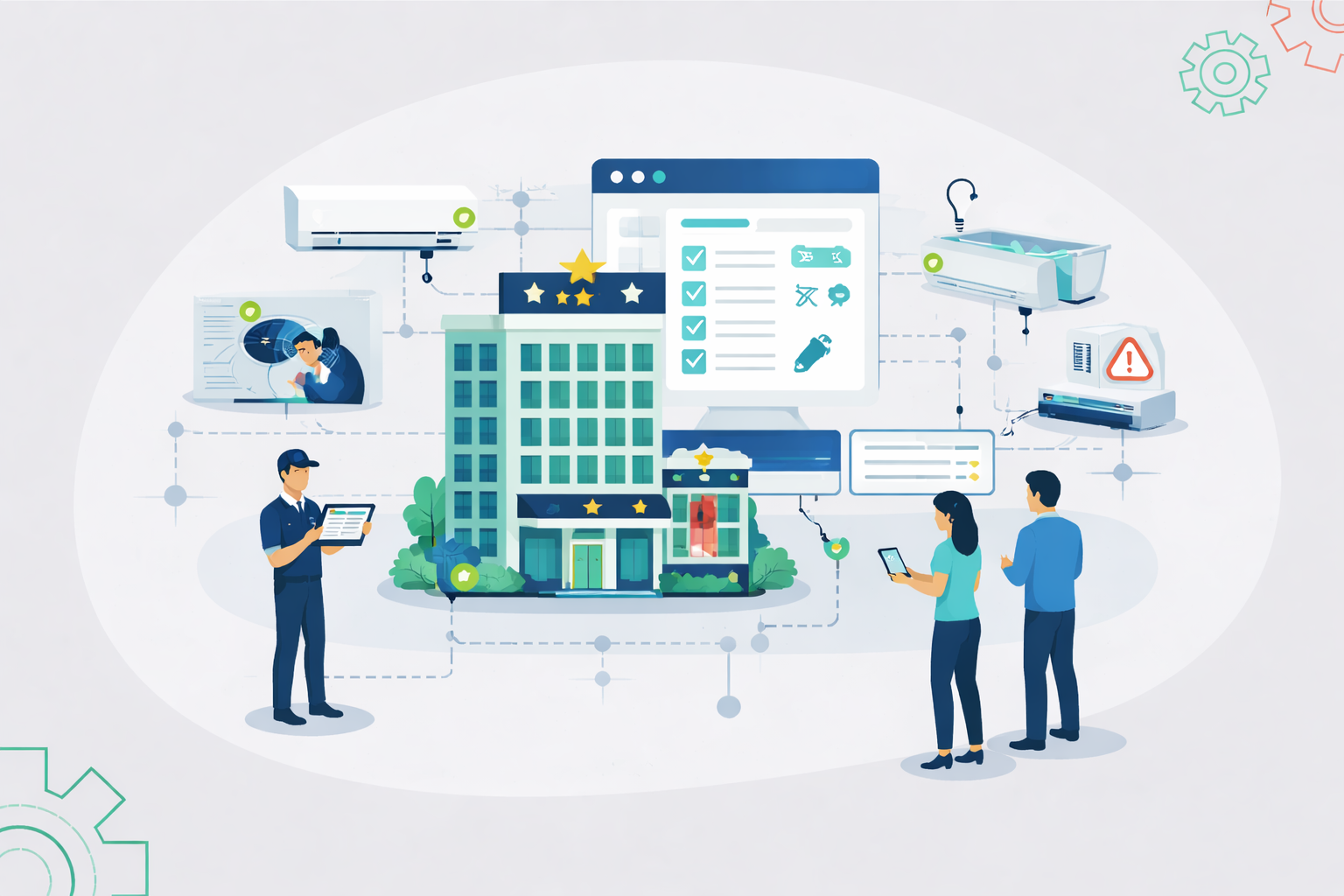
Hotels operate in a very tough market, mainly because both competition and guest expectations run extremely high. Add to this the challenge of balancing operational costs while staying within a price point that doesn’t drive customers away. This is no easy feat for hotel management, since much of it comes down to hotel maintenance, which can be the dividing line between a satisfied customer and an unhappy one. From a maintenance standpoint, a malfunctioning air conditioner, flickering lights, an inaccessible Wi-Fi connection, or a slow response to a plumbing issue can quickly trigger a negative review. And when it comes to the latter, operational inefficiencies appear almost instantly on review platforms. It goes without saying that these can directly impact revenue.
For this reason and others, understanding and investing in the right hotel maintenance software features is no longer optional. This is because modern maintenance technology doesn’t just fix problems faster, it prevents them. It also improves communication across departments and protects a hotel’s brand reputation.
This article explores the essential hotel maintenance software features that help properties improve guest satisfaction, increase operational efficiency, and ultimately drive stronger ratings.
Why Hotels Can’t Rely on Manual Maintenance Systems Anymore
Historically, hotels relied on paper logs, whiteboards, spreadsheets, or radio communication to manage maintenance tasks. While these methods may have worked in the past, today’s demands make them both inefficient and costly in the long term. This is mainly because they are subject to the following limitations:
- Lost or delayed work orders
- Poor communication between maintenance and the front desk
- No preventive scheduling
- Lack of performance visibility
- Inconsistent response times
Given today’s digital-first hospitality environment, where a single negative review can influence dozens of booking decisions, it’s a no-brainer that reactive maintenance simply isn’t enough. To operate efficiently, hotels need structured systems that provide accountability, automation, and transparency. With modern hotel maintenance software features, silos can be eliminated, departments connected, and workflows streamlined from guest request to resolution.
Core Hotel Maintenance Software Features Every Property Needs
Before exploring advanced capabilities, let’s first examine the foundational hotel maintenance software features that every property should have in place. These core functions form the operational backbone of an efficient maintenance program, ensuring tasks are tracked, assets are protected, and communication flows seamlessly between departments. Without these essentials, hotels risk delayed repairs, inconsistent service, and guest experiences that suffer.
Work Order Management
At the heart of any maintenance platform is work order management. In short, this involves the ability to create, assign, track, and close tasks efficiently.
A strong work order system allows staff to:
- Submit repair requests digitally.
- Assign tasks by priority level.
- Track progress from submission to completion.
- Attach notes, photos, and documentation.
- Automatically notify supervisors of delays.
For example, when a guest reports a leaking faucet, the front desk can immediately generate a work order in the system. The maintenance technician receives it on a mobile device, updates the status in real time, and marks it complete once resolved.
Having this level of visibility ensures nothing falls through the cracks, a critical factor in maintaining positive guest experiences. When evaluating hotel maintenance software, robust work order management should be a non-negotiable, top priority.
Preventive Maintenance Scheduling
Reactive maintenance impacts both budgets and reputations. Preventive maintenance scheduling automates recurring inspections and servicing for assets such as:
- HVAC systems
- Elevators
- Plumbing
- Electrical systems
- Kitchen equipment
- Pools and spas
Instead of waiting for breakdowns, the system automatically generates work orders based on time intervals or usage thresholds.
The benefits include:
- Reduced emergency repairs
- Lower asset downtime
- Extended equipment lifespan
- Improved room availability
- Greater compliance with safety standards
Preventive maintenance directly impacts ratings. Guests rarely praise working air conditioning. Alternatively, they immediately complain when it doesn’t function. Preventing issues before guests notice them is one of the most powerful features of hotel maintenance software.
Real-Time Status Updates
Speed matters in the hospitality industry. Maintenance teams must communicate instantly with the front desk and housekeeping.
Real-time status updates allow technicians to:
- Update room repair status via mobile devices.
- Mark rooms “out of order” or “ready for sale” immediately.
- Upload photos to confirm completion.
- Communicate directly within the platform.
This feature eliminates constant phone calls and guesswork. The front desk can confidently inform guests when issues will be resolved, and housekeeping can plan cleaning schedules accordingly.
Real-time visibility also reduces check-in delays, improves room turnover, and enhances overall guest satisfaction.
Among modern hotel maintenance software features, mobile-first functionality and live updates are essential for operational efficiency.
Asset Tracking and Management
Hotels operate thousands of physical assets, ranging from guest-room appliances to large mechanical systems. Without proper tracking, it’s impossible to manage lifecycle costs effectively.
Asset tracking and management features provide:
- A centralized database of all equipment
- Maintenance history logs
- Warranty tracking
- Service documentation storage
- Lifecycle cost analysis
This allows managers to see patterns. If a specific HVAC unit brand requires frequent repairs, replacement decisions can be data-driven rather than reactive.
Better asset visibility reduces long-term costs and ensures reliable guest room functionality, both of which are major contributors to improved ratings.
Inventory Control
Maintenance delays often stem from missing parts. Inventory control ensures technicians have what they need when they need it.
Key inventory capabilities include:
- Tracking spare parts and tools
- Monitoring usage trends
- Automated low-stock alerts
- Supplier management
- Cost tracking
When a technician can immediately access required materials, repairs are completed faster, thus minimizing guest inconvenience.
Inventory control may seem operationally focused, but it’s one of the hotel maintenance software features that directly reduces downtime and prevents prolonged room outages.
Guest Request Integration
One of the most powerful features available today is guest request integration, which eliminates the communication gap between the guest experience and the maintenance team. Instead of relying on phone calls, handwritten notes, or manual data entry, guest-submitted issues are automatically converted into digital work orders via mobile app, in-room tablet, QR code, or front desk system. This creates an immediate, trackable workflow from the moment the guest reports a problem.
Guest request integration also reduces human error and delays. When requests are manually relayed, details can be lost, miscommunicated, or deprioritized. Direct system integration ensures the issue is logged accurately, assigned promptly, and visible to supervisors in real time. That transparency not only accelerates response times but also improves accountability across departments.
Perhaps most importantly, guest request integration enhances perception. Even if a repair takes time, guests appreciate fast acknowledgment and clear updates. When staff can confidently provide real-time status information, it builds trust and reinforces the impression of an organized, responsive property. In today’s review-driven hospitality environment, that responsiveness can be the difference between a neutral stay and a five-star rating.
When a guest submits a maintenance concern, it automatically converts into a work order, eliminating the need for manual entry that can cause delays.
In hospitality, perception matters as much as resolution. A fast, organized response can turn a potential complaint into a positive review.
Advanced Hotel Maintenance Software Features That Provide a Competitive Edge
While core hotel maintenance software features ensure operational stability, advanced capabilities truly differentiate high-performing properties. In a competitive hospitality landscape, leading hotels leverage deeper analytics, automation, and multi-property visibility to move beyond reactive efficiency and toward strategic optimization. These advanced tools not only streamline maintenance operations but also create measurable advantages in cost control, brand consistency, and guest satisfaction. Let’s look at these features now.
Reporting and Analytics
Data-driven decision-making is critical. Advanced dashboards can track:
- Average response times
- Work order completion rates
- Asset downtime
- Preventive maintenance compliance
- Technician productivity
These insights allow leadership to identify bottlenecks and continuously improve performance.
Multi-Property Management
For hotel groups and management companies, centralized oversight across multiple properties ensures:
- Standardized maintenance procedures
- Consistent brand standards
- Comparative performance analytics
- Simplified reporting
Multi-property visibility strengthens operational consistency, resulting in consistent guest experiences.
Role-Based Permissions and Accountability
Clear accountability improves performance. Role-based permissions ensure:
- Supervisors approve major repairs
- Technicians access only relevant tasks.
- Managers maintain reporting oversight.
This structure reduces confusion and enhances operational discipline.
How These Hotel Maintenance Software Features Improve Online Ratings
Online ratings are not just marketing metrics; they are revenue drivers. A half-star difference on review platforms can significantly impact booking volume, average daily rate (ADR), and long-term brand perception. The right hotel maintenance software features directly influence the operational consistency guests experience and the reviews they leave.
Faster Response Times
Guests expect a quick resolution when something goes wrong in their room. When maintenance teams receive work orders instantly and update statuses in real time, response times shrink dramatically. Faster service recovery not only resolves issues efficiently but also reassures guests that their comfort is a priority, often preventing negative reviews altogether.
Fewer Room Outages
Preventive maintenance scheduling reduces unexpected equipment failures that force rooms out of service. When HVAC systems, plumbing fixtures, lighting, and appliances are proactively maintained, hotels experience fewer last-minute room changes and overbooking complications. Consistent room availability improves operational stability and prevents the frustration that frequently leads to poor ratings.
Improved Comfort and Safety
Guests may not notice perfectly functioning systems. However, what they immediately notice is something that fails. Reliable temperature control, quiet plumbing, safe lighting, and well-maintained elevators contribute to a seamless stay experience. Strong hotel maintenance software features ensure these behind-the-scenes systems operate consistently, supporting the comfort and safety standards that drive positive reviews.
Better Communication Across Departments
When front desk, housekeeping, and maintenance have real-time visibility into room status and repair progress, communication becomes proactive rather than reactive. Staff can confidently update guests, manage expectations, and coordinate room turnover without confusion. This operational transparency enhances professionalism and instills confidence in guests regarding the hotel’s service quality.
Data-Driven Continuous Improvement
Maintenance software provides measurable insights into response times, recurring issues, and trends in asset performance. By analyzing this data, hotel leadership can identify patterns, such as equipment failures or recurring guest complaints. This valuable data enables systematic root-cause analysis. Continuous improvement based on real data leads to consistently better experiences, which naturally translate into stronger online ratings.
Evaluating the Right Hotel Maintenance Software
Selecting a maintenance platform is more than just a technology purchase. Instead, it involves a strategic operational decision that will directly influence guest satisfaction, efficiency, and long-term profitability. With numerous vendors offering overlapping capabilities, hotel leaders must carefully evaluate options to ensure the system aligns with current needs and future growth plans. The right solution should not only include essential hotel maintenance software features but also integrate seamlessly into your broader hospitality ecosystem.
Scalability for Your Property Size
Since not all hotels operate at the same scale, your maintenance platform should reflect your facility’s needs. A boutique property may need streamlined functionality, while a large resort or a multi-property group requires advanced reporting, robust asset management, and centralized oversight. Choosing scalable hotel maintenance software ensures the system can grow alongside your property without requiring costly replacements later.
Ease of Use for Technicians and Front Desk Staff
Even the most feature-rich system will fail if it’s difficult to use. Technicians need intuitive mobile access to quickly update work orders, while front desk staff should be able to submit and track requests without navigating complex menus. A user-friendly interface accelerates adoption, reduces training time, and increases overall operational efficiency.
Cloud-Based Accessibility
Cloud-based solutions provide flexibility and real-time access from anywhere on the property, or even off-site. Managers can monitor performance metrics remotely, while technicians receive instant updates on mobile devices. In addition, cloud platforms typically offer automatic updates and stronger data security than legacy on-premises systems.
Integration Capabilities with Your PMS and Other Systems
Seamless integration with your Property Management System (PMS), housekeeping software, and guest apps is critical. Without integration, staff are forced to duplicate data entry, increasing errors and slowing response times. Strong integration capabilities automatically route maintenance requests into work orders, improving speed, accuracy, and guest satisfaction.
CMMS Vendor Support and Onboarding Resources
Implementation success often depends on the CMMS vendor as much as the software itself. Look for providers that offer structured onboarding, responsive technical support, and ongoing training resources. A strong support partnership ensures your team fully leverages available hotel maintenance software features and continues to optimize performance over time.
CMMS Software Implementation Best Practices
Selecting the right system is just half the equation. The other half involves successful execution, which will determine how well your investment will deliver results. Implementing CMMS software requires thoughtful planning, cross-department coordination, and clear performance goals to ensure adoption and long-term value. By following proven best practices, hotels can accelerate user acceptance, minimize disruption, and quickly translate new technology into measurable improvements in efficiency and guest satisfaction.
Secure Leadership Buy-In
Successful implementation starts at the top. When hotel leadership clearly communicates that maintenance software is a strategic investment tied directly to guest satisfaction and ratings, teams are more likely to take adoption seriously. Executive support also ensures proper budgeting, staffing alignment, and accountability throughout the rollout process.
CMMS Software Training for All Departments
Hotel maintenance software does not operate in isolation because it affects maintenance, front desk, housekeeping, and sometimes even guest services. Comprehensive training ensures every department understands how to submit requests, track their status, and communicate within the system. Cross-departmental training reduces confusion, eliminates workarounds, and creates a unified workflow that supports faster service delivery.
Migrate Asset and Location Data Carefully
Accurate asset data is the foundation of preventive maintenance and reporting. Before launching the system, hotels should conduct a thorough audit of existing equipment lists, warranty documentation, and maintenance histories to ensure clean, complete data entry. Poor data migration can lead to missed preventive schedules, inaccurate reporting, and diminished trust in the system.
Establish Performance Benchmarks
Technology alone does not improve operations, but measurement does. Hotels should establish clear KPIs such as average response time, work order completion rate, preventive maintenance compliance, and asset downtime before full implementation. Tracking these metrics allows management to quantify improvements and continuously refine maintenance processes.
Continuously Optimize
Implementation is not a one-time event but an ongoing process. Regularly reviewing system reports and technician feedback helps identify workflow inefficiencies, training gaps, or underused features. Continuous optimization ensures the hotel maximizes the value of its maintenance software and sustains long-term improvements in operational performance and guest satisfaction.
Conclusion
Maintenance is often viewed as a behind-the-scenes function, only becoming apparent when things go wrong.
The right hotel maintenance software features transform maintenance from reactive problem-solving into proactive experience management. Work order automation, preventive scheduling, real-time communication, asset tracking, inventory control, and guest integration all contribute to smoother operations and stronger reviews.
In a competitive hospitality environment, operational excellence is inseparable from brand reputation. Investing in modern maintenance technology involves much more than fixing equipment; it’s about protecting ratings, revenue, and long-term success.
TABLE OF CONTENTS




Keep Reading
Every day, facility managers juggle numerous responsibilities. Work orders need attention, ...
16 Sep 2026
Equipment breakdowns cost more than the repair bill. Lost production, overtime labor, and ...
15 Sep 2026
Maintenance-as-a-Service (MaaS) is transforming how organizations manage their equipment and ...
11 Sep 2026
Maintenance as a Service (MaaS) is one of the newer concepts in maintenance management that ...
11 Sep 2026
Choosing a CMMS is a high-stakes decision. Get it right, and your maintenance team moves from ...
3 Sep 2026
Construction Management Software: A Step-by-Step Guide by Click Maint Construction teams ...
3 Sep 2026
Construction Management Software By Click Maint Construction companies live and die by ...
3 Sep 2026
Restaurant CMMS: The Best Maintenance Software for Restaurants and the Food Industry When ...
1 Sep 2026
Educational facilities endure heavier wear and tear than most other buildings. Balancing ...
1 Sep 2026
Parts Inventory Management Software by Click Maint Searching for parts inventory management ...
1 Sep 2026
Work Order Management Software If you're responsible for equipment upkeep, responding to ...
28 Aug 2026
Best CMMS for Growing Manufacturers For growing manufacturers, choosing the right ...
28 Aug 2026
A Definitive Guide for Growing Manufacturers For growing manufacturers, equipment downtime is ...
28 Aug 2026
Introduction For maintenance managers and facilities leaders at small to mid-sized multi-site ...
27 Aug 2026
Introduction If your maintenance operation still runs on spreadsheets, whiteboards, relies on ...
25 Aug 2026
When a machine breaks, the maintenance team needs the right part fast. If parts are missing, ...
19 Aug 2026
Introduction The landscape of facility maintenance is transitioning into a more strategic ...
21 Jul 2026
Introduction A growing maintenance backlog is a telltale sign that the maintenance team is ...
14 Jul 2026
Introduction Tracking the right maintenance KPIs is the difference between a reactive ...
7 Jul 2026
Introduction For many organizations, maintenance tracking starts with a spreadsheet. It is ...
30 Jun 2026