Reena Sommer | 12 Feb 2026


The energy industry is facing numerous challenges on several fronts, including the transition to smart-grid technology, geopolitical instability and price volatility, increased demands for system security, and supply chain issues. In addition to these issues, industry leaders are tasked with managing aging infrastructure, rising demand, tighter regulations, and the push toward sustainability.
When all these issues converge, there is little room for downtime or inefficiency. In this high-stakes environment, traditional maintenance approaches are insufficient. That’s where the AI Computerized Maintenance Management System (CMMS) for the Energy Industry is making a powerful impact. By combining artificial intelligence with computerized maintenance management systems, energy organizations are transforming maintenance from a reactive cost center into a strategic driver of reliability, safety, and performance. The result? Smarter decisions, fewer failures, and a more resilient energy ecosystem.
Here, we’ll explore the issues related to the energy industry’s move toward adopting the AI CMMS approach. We’ll begin by diving deeper into some background on the subject.

The Energy Sector’s Maintenance Challenges
Maintenance in the energy industry has always been complex. However, today’s challenges are amplified by scale, risk, and operational expectations. One problem is that many energy organizations still rely on reactive or time-based maintenance strategies that struggle to keep pace with increasingly sophisticated assets. Equipment such as turbines, generators, substations, and grid infrastructure operates continuously under demanding conditions. In a reactive maintenance scenario, this makes unanticipated and preventable failures both costly and disruptive.
Moreover, unplanned downtime in the energy sector can ripple far beyond a single facility, impacting grid stability, customer trust, and regulatory compliance. More specifically, a single equipment failure can result in service interruptions, safety hazards, environmental risks, and significant financial losses. At a time when maintenance teams are often stretched thin, managing vast asset networks with limited visibility into real-time equipment health adds to the stress of running an energy plant efficiently.
Compounding these issues are legacy systems and siloed data. In this instance, maintenance records, sensor data, and operational insights are frequently disconnected. The result is that maintenance teams struggle with identifying early warning signs of failure. Without predictive intelligence, organizations are left reacting to problems after they occur—rather than preventing them altogether. Considered together, these pressures have become a motivating force in seeking a more intelligent, proactive approach to maintenance. And that’s where an AI CMMS for the Energy Industry approach comes into play.

What is AI CMMS?
At its core, a CMMS is designed to organize maintenance activities. By that, we mean it can track assets, manage work orders, schedule preventive maintenance, and control spare parts inventory. Traditional CMMS platforms are noted for helping energy organizations bring structure and consistency to maintenance operations. However, in this early form, they primarily rely on human input and static rules, limiting their ability to adapt to changing conditions or to uncover deeper insights.
AI CMMS for the energy industry builds on this foundation by embedding artificial intelligence and machine learning into the system. By analyzing historical data, real-time sensor inputs, and operational patterns, AI-powered CMMS anticipates what is likely to happen next. This shift transforms CMMS from a digital filing cabinet into an intelligent decision-support system.
Today’s modern AI CMMS platforms typically integrate two powerful AI capabilities. In other words, generative AI can enhance knowledge access by summarizing maintenance histories, suggesting corrective actions, and supporting technicians with contextual guidance. With agentic AI, the CMMS’s capabilities go even further: it enables the system to act autonomously. It does this by triggering inspections, prioritizing work orders, or recommending maintenance strategies based on asset criticality and operating conditions.
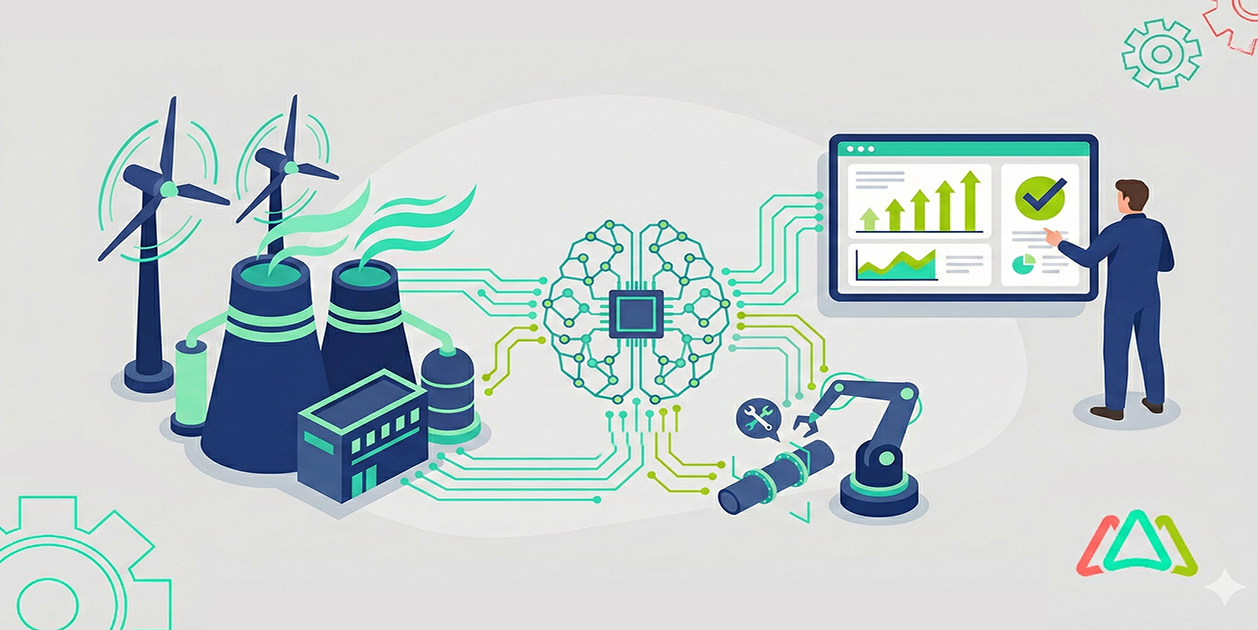
For the energy industry, where equipment reliability is critical, this form of intelligence is game-changing: an AI CMMS can integrate data from IoT sensors, SCADA systems, and operational technologies to create a unified view of asset health. It continuously learns from new data, refining predictions and recommendations over time. The result is that organizations using this technology have a maintenance system that not only supports day-to-day operations but also actively drives reliability, safety, and efficiency across energy assets.
Core Capabilities of AI CMMS for the Energy Industry
Predictive Maintenance: Anticipating Failures Before They Happen
Predictive maintenance is one of the most transformative capabilities of the AI CMMS because it has changed how energy organizations manage asset reliability. Unlike preventive maintenance, which relies on fixed schedules, predictive maintenance uses artificial intelligence and machine learning to determine when maintenance is needed based on real operating conditions.
AI CMMS analyzes data from multiple sources, including IoT sensors, historical maintenance records, equipment performance metrics, and environmental conditions. By identifying patterns and subtle anomalies, the system can predict potential failures long before they escalate into costly breakdowns. For example, abnormal vibration levels in a turbine or rising temperatures in electrical components can signal early-stage degradation that, without AI capabilities, would likely go unnoticed.
For energy operators, this capability dramatically reduces unplanned downtime. More specifically, maintenance teams can intervene at the optimal moment, thus minimizing disruptions to power generation and distribution. Predictive maintenance also improves planning accuracy, allowing teams to schedule repairs during low-demand periods and coordinate labor and materials more efficiently.
Beyond reliability, predictive maintenance supports long-term asset health. By preventing excessive wear, overheating, or cascading failures, AI CMMS helps extend the lifespan of critical energy assets while reducing overall maintenance costs. In an industry where infrastructure investments are substantial and operational continuity is non-negotiable, predictive maintenance delivers measurable, compounding value.
Real-Time Anomaly Detection and Condition Monitoring
Real-time anomaly detection is another critical capability of AI CMMS for the energy industry, enabling continuous oversight of energy assets operating under demanding conditions. By collecting live data from sensors, control systems, and connected devices, AI CMMS continuously monitors variables such as temperature, pressure, vibration, voltage, and load performance.
What sets AI-driven monitoring apart from systems that do not utilize this technology is its ability to recognize subtle deviations from standard operating patterns. These are the critical signals that traditional threshold-based systems typically lack. Instead of waiting for a defined parameter to exceed a predefined limit, AI identifies abnormal trends and correlations that indicate early-stage issues. When the AI technology detects anomalies, the system can automatically generate alerts, recommend corrective actions, or trigger work orders before performance degrades or failures occur.
For energy operations, this level of visibility significantly improves reliability and operational confidence. Assets such as transformers, turbines, and substations can be monitored around the clock, reducing the risk of sudden outages while enhancing situational awareness across geographically dispersed sites.
Intelligent Work Order Management and Automation
Work order management has long been a core function of CMMS. Still, AI-enabled CMMS for the energy industry extends this capability by transforming it from an administrative task into a strategic function. AI-driven systems intelligently prioritize work orders based on asset criticality, failure risk, operational impact, and safety considerations. The result is that this approach ensures that the most urgent issues receive immediate attention.
AI CMMS can also automate work order creation in response to detected anomalies or predictive insights. Rather than relying on manual inspections or delayed reporting, the system proactively assigns tasks to the right technicians based on skills, availability, and location. This reduces response times, eliminates bottlenecks, and improves workforce productivity.
In energy environments where downtime has profound consequences, intelligent work order automation ensures maintenance efforts are aligned with operational priorities. Maintenance teams spend less time managing paperwork and more time executing high-value work that keeps energy systems running smoothly.
Optimized Resource and Inventory Management
Managing spare parts and maintenance resources across large energy operations is both complex and costly. AI CMMS for the energy industry addresses this challenge by using predictive analytics to optimize inventory levels and resource allocation.
By analyzing historical usage patterns, failure probabilities, and lead times, AI CMMS forecasts future parts demand with far greater accuracy. This helps energy organizations avoid excess inventory while ensuring critical components are available when needed. The result is a reduction in carrying costs, fewer emergency purchases, and improved maintenance readiness.
Resource optimization extends beyond inventory control. AI CMMS also helps schedule labor more effectively by aligning technician availability with projected maintenance needs. For energy organizations operating across multiple sites, this coordinated approach significantly improves efficiency while reducing operational waste.
Data-Driven Decision Support and Strategic Insights
One of the most significant advantages of AI CMMS in the energy industry is its ability to assimilate and convert vast amounts of maintenance and operational data into actionable insights. AI-driven dashboards and analytics provide maintenance leaders with a clear, real-time view of asset health, performance trends, and risk exposure.
Instead of relying on time-limited static reports or historical averages, decision-makers gain forward-looking intelligence that supports strategic planning. AI CMMS can highlight underperforming assets, recommend maintenance strategy adjustments, and identify opportunities to improve energy efficiency and sustainability.
This level of insight raises maintenance from a reactive support function to a strategic contributor. By enabling informed, data-backed decisions, AI CMMS empowers energy organizations to improve reliability, control costs, enhance safety, and support long-term operational goals.
Real Impact of AI CMMS in the Energy Industry
The value of AI CMMS in the energy industry becomes most evident when its capabilities translate into measurable operational improvements. By this, we mean that rather than achieving incremental gains, AI-driven maintenance delivers compounding benefits across reliability, cost control, safety, and sustainability. These are the areas where the energy sector cannot afford missteps.
Reduced Downtime and Improved Reliability
Unplanned downtime is one of the most expensive risks in the energy industry. AI CMMS significantly reduces this risk by enabling early fault detection and predictive interventions. By addressing equipment issues before failures occur, energy organizations experience fewer outages, more stable operations, and improved service continuity.
For power generation facilities and grid operators, improved reliability strengthens system resilience and customer trust. Maintenance teams are no longer reacting to emergencies; they are executing planned, informed interventions that keep assets operating at peak performance.
Lower Maintenance and Operating Costs
AI CMMS helps energy organizations move from costly, reactive maintenance and inefficient over-maintenance. Predictive insights ensure maintenance is performed only when necessary, reducing labor, parts replacement, and downtime-related expenses.
Inventory optimization further contributes to cost savings by minimizing excess stock while preventing critical shortages. Over time, these efficiencies add up to substantial reductions in total maintenance and operational costs. The result is that budgets become free to move forward with modernization, expansion, or sustainability initiatives.
Enhanced Safety and Regulatory Compliance
Safety is non-negotiable in the energy industry, where equipment failures can pose serious risks to personnel, communities, and the environment. AI CMMS for the energy industry makes these safety outcomes achievable by identifying abnormal conditions early and ensuring timely corrective actions.
Automated maintenance documentation, inspection tracking, and audit-ready records also simplify regulatory compliance. AI-driven insights help organizations demonstrate adherence to safety standards and maintenance best practices, reducing compliance risk and improving transparency.
Extended Asset Life and Capital Protection
Energy infrastructure requires significant capital investment. For this reason, extending asset lifespans is a strategic priority. AI CMMS supports this goal by preventing excessive wear, overheating, and cascading failures that shorten equipment life.
By maintaining assets within optimal operating conditions, organizations delay costly replacements and maximize return on investment. A proactive approach like this helps stabilize long-term capital planning and reduces pressure on maintenance and engineering teams.
Sustainability and Energy Efficiency Gains
Sustainability goals are increasingly embedded into maintenance strategies. AI CMMS for the energy industry supports these goals by identifying inefficiencies, such as energy losses, underperforming assets, and recurring maintenance issues, that increase environmental impact.
Improved equipment efficiency reduces energy waste, lowers emissions, and promotes more responsible resource use. As energy organizations pursue decarbonization and resilience initiatives, AI CMMS becomes a foundational tool for aligning operational performance with sustainability objectives.
Conclusion
The energy industry is entering a new era defined by intelligence, resilience, and accountability. As infrastructure grows more complex and operational expectations rise, maintenance can no longer afford to be reactive or disconnected from real-time conditions. In meeting this challenge, AI CMMS for the energy industry is proving to be a critical enabler of this shift, transforming maintenance into a proactive, data-driven discipline that strengthens reliability, safety, and sustainability.
By combining predictive analytics, real-time monitoring, intelligent automation, and decision support, AI CMMS empowers energy organizations to anticipate problems rather than react to them. The result is that organizations experience fewer outages, lower costs, safer operations, and longer-lasting assets. Considered together, these are outcomes that matter deeply in an industry where performance and trust are inseparable.
TABLE OF CONTENTS