Reena Sommer | 16 Jun 2026


Artificial intelligence (AI) first appeared in 1956, when it was unveiled at the Dartmouth Summer Research Conference. Then, AI was in its infancy in the hands of academics. However, by 2023, AI had finally become mainstream, with information-generating tools such as ChatGPT widely used. At the same time, AI has increasingly piqued the interest of a wide range of industry sectors, prompting software developers to make it available as a cutting-edge tool.
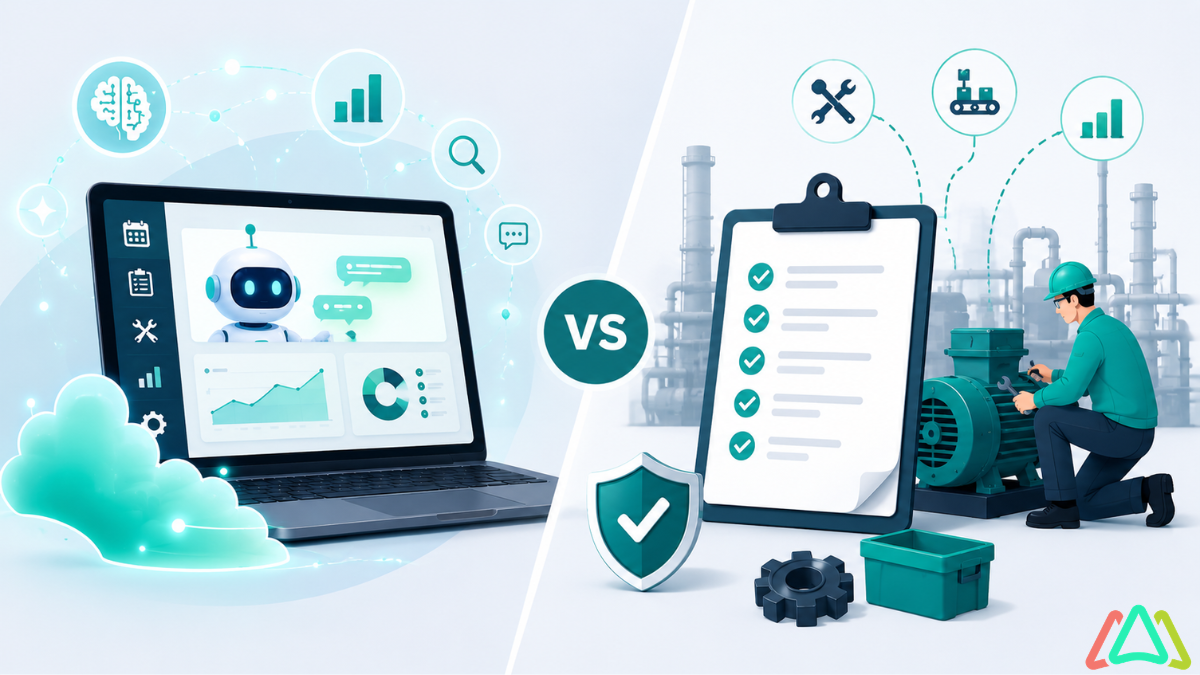
Today, many software providers claim that their platforms have AI capabilities. This is also true in the maintenance and facilities management software space. If you do an online search, you will see that many of the leading CMMS providers like Upkeep, Brightly, Limble, and others boast AI-powered functionality. These providers promote AI work order software as the next breakthrough in operational efficiency. AI work order software is touted as capable of automatically creating work orders, predicting failures, scheduling technicians, reducing downtime, and continuously improving itself, which could transform maintenance teams. This is appealing to organizations dealing with labor shortages and pressure to reduce costs.
These promising claims raise the question: how much of it is real, and how much is simply rebranded automation with a modern label?
The truth lies somewhere in the middle. AI is creating genuine improvements in work order management, but many claims still exceed what current systems can realistically deliver. Here, we’ll clarify this issue to help you make informed decisions when selecting a Computerized Maintenance Management System (CMMS Software).
What is AI Work Order Software?
At its core, AI work order software is a work order management or CMMS platform that leverages artificial intelligence, machine learning, advanced analytics, and intelligent automation to improve maintenance workflows.
AI-enhanced systems build on traditional work order software, which primarily helped teams to create and assign work orders, track labor and parts, schedule preventive maintenance, store asset history and monitor completion status.
AI work order software goes several steps further by helping teams make smarter decisions automatically. For example, instead of simply recording a maintenance request, an AI-enabled platform may prioritize the request based on equipment criticality, production impact, repair history, or technician availability.
The Hype: What CMMS Software Providers Promise
Many software companies market AI as a revolutionary force that can solve long-standing maintenance challenges. Some of these claims contain truth, but they often oversimplify what’s really involved. Let’s look at this more closely.
Automatic Work Order Creation
One common promise is that systems can automatically detect issues and generate work orders instantly. In some cases, this is possible. For example, vibration sensors or temperature monitoring devices may trigger alerts when equipment conditions exceed acceptable limits. Those alerts can feed into software that automatically creates a work order.
The reality, though, is that this capability depends heavily on having connected assets, functioning sensors, and properly configured thresholds.
Smarter Scheduling and Dispatching
Another frequent claim is intelligent scheduling. Vendors often suggest that the software can assign the best technician based on skill set, availability, certifications, workload, and proximity.
This scheduling capability can improve efficiency, especially in field service or multi-site environments. But it still requires accurate employee data, realistic schedules, and human oversight.
Predictive Maintenance
The most attractive promise from vendors is that AI work order software can predict failures before they occur.
This is one of the most legitimate uses of AI, but it is also one of the most misunderstood. Predictive models can identify patterns that suggest rising failure risk, but they require sufficient historical data and stable operating conditions to be effective.
Reduced Labor Costs
Some vendors imply that AI can replace planners, dispatchers, or administrative staff.
The reality is that AI more often reduces repetitive work but does not entirely replace people. AI work order software can automate low-value tasks, allowing staff to focus on higher-level decisions.
Continuous Optimization
Another common selling message is that software “learns and gets smarter over time.”
Indeed, this can happen when systems analyze new maintenance data and refine recommendations. But improvement is simply not automatic. It depends on data quality, user adoption, and ongoing process discipline.
The Reality: What AI Work Order Software Can Actually Deliver Today
While marketing can be exaggerated, AI is nevertheless already creating measurable value in many organizations.
Workflow Automation That Saves Time
One of the most practical benefits of AI work order software is its ability to automate common workflows by routing requests to the right department, escalating overdue work orders, prioritizing emergency tasks, automatically sending approvals, and triggering follow-up inspections.
These features reduce manual coordination and speed response times.
Better Planning Through Historical Data
AI tools can analyze maintenance history faster than humans can manually review spreadsheets.
Among its capabilities, AI work order software can help identify recurring equipment failures, chronic backlogs, delays caused by missing parts, poorly timed preventive maintenance intervals, and high-cost assets needing replacement review.
With AI-enhanced systems, much of the guesswork is removed, allowing teams to use data-driven insights.
Technician Productivity Improvements
Many newer CMMSs support technicians directly in the field. They do this by offering suggested troubleshooting steps, instant access to repair history, searchable manuals and SOPs, voice-to-text work order notes, and auto-generated summaries of completed work.
Considered together, these AI-enhanced tools reduce time spent searching for information and improve documentation quality.
Predictive Maintenance for Critical Assets
Predictive maintenance represents the latest generation of preventive maintenance, capable of delivering strong ROI when applied selectively.
In this regard, it works best for high-value equipment, assets with costly downtime, machines with available sensor data, repetitive failure patterns, and operations where uptime is critical.
On the other hand, predictive maintenance approaches are usually less effective when applied broadly across all low-risk assets.
Where the AI Work Order Software Hype Breaks Down
As is true with any software application, even the best AI work order software cannot overcome poor fundamentals. Consider the following:
Bad Data Creates Bad Results
If asset records are incomplete, inconsistent, or outdated, AI recommendations become unreliable. It’s a simple matter of “garbage in - garbage out”!
Common data-related issues include:
-
Duplicate assets
-
Missing failure codes
-
Inaccurate PM histories
-
Poor naming conventions
-
Incomplete labor tracking
It’s not uncommon for organizations to discover that they need data cleanup before AI delivers value.
AI Does Not Replace Skilled Technicians
AI is a technology, not a human. For this reason, maintenance still depends on experience, judgment, and hands-on expertise.
Software may suggest likely causes of a motor issue, but it cannot inspect alignment, hear abnormal sounds, or apply practical judgment the way a skilled technician can.
AI should be viewed as a support tool, not a replacement for technical talent.
AI is Often Automation That’s Rebranded
Not every smart feature is true artificial intelligence; it is just given that label.
If software simply uses fixed rules, such as:
-
If overdue by 7 days, escalate
-
If the machine stops, create a ticket
-
If the technician is unavailable, reassign
That may be useful automation, but it is not advanced AI and should not be mistaken as such. Buyers need to understand the difference.
ROI Is Never Automatic
Buying software alone does not create savings. It’s just a tool. Instead, returns depend on:
-
User adoption
-
Clean processes
-
Management support
-
Training
-
Accurate data entry
-
Clear KPIs
Without consideration of all of these issues, even powerful tools will underperform.
Questions to Ask Vendors Before Buying AI work order Software
To separate real value from marketing noise when considering AI-enhanced applications, ask direct questions.
What AI Features Are Included?
Determine whether AI functionality is built into the base product or sold as an expensive add-on.
What Data Is Required?
Ask how much historical maintenance data is needed for predictions or recommendations.
Do We Need Sensors or Integrations?
Some advanced features require IoT devices, ERP connectivity, or condition monitoring systems. If your organization does not have these, consider the cost, time, and effort required to acquire them.
Can Users Override Recommendations?
Maintenance teams need final control over scheduling and priorities.
How Are Decisions Explained?
If the software prioritizes one work order over another, users should understand why. Blindly relying on software-generated findings is inadvisable.
What Real Results Have Customers Achieved?
Request real examples tied to metrics such as:
-
Lower downtime
-
Faster response times
-
Improved PM compliance
-
Reduced backlog
-
Lower overtime costs
When AI work order Software Is Worth It
Buyers want to know whether the product they are considering will fit their needs and deliver results. The following situational and logistical factors point to when organizations will often benefit most from AI work order software:
-
Large asset counts
-
Multiple facilities
-
Expensive downtime
-
Labor shortages
-
Mature maintenance processes
-
Reliable historical data
-
A desire to scale operations efficiently
In these environments, even modest gains can justify investment.
When Traditional Work Order Software May Be Better
Not every organization needs AI immediately. For some, AI work order software is premature or simply a poor fit.
Here is when a standard work order software may be the smarter first step:
-
Operations are small or simple
-
Work order volume is low
-
Preventive maintenance is inconsistent
-
Staff resist current systems
-
Data quality is poor
-
Budgets are limited
Sometimes mastering the basics creates more value than chasing advanced features too early.
How to Evaluate AI Work Order Software
The smartest approach to purchasing AI work order software is both practical and disciplined.
Start Small
Run a pilot in one plant, department, or asset group.
Define One Success Metric
Examples:
-
Reduce response time by 20%
-
Cut emergency work orders by 15%
-
Improve wrench time by 10%
Clean Your Data First
As already noted, ensure assets, parts, labor records, and failure codes are accurate.
Demand Proof
The onus is on the buyer to ensure their needs can be met by AI work order software. So even before making a purchase, ask vendors for live demonstrations, customer references, before-and-after results, and clear implementation requirements. AI has a lot of sizzle, but before buying into it, ensure that the capabilities work for your organization and will have a positive impact that justifies the cost.
The Future of AI Work Order Software
The next generation of work-order tools will likely be more useful and less flashy.
We can expect advances such as voice-generated work orders from mobile devices, improved spare parts demand forecasting, AI copilots for technicians, smarter scheduling across multiple plants, stronger integration with IoT and ERP systems, and natural-language reporting and analytics.
As the technology matures, the best results will be seen by companies that combine AI with strong maintenance fundamentals.
Conclusion
AI work order software is a real and helpful tool, but it's not a magical fix that instantly solves every problem. The reality is that it delivers real benefits in workflow automation, planning insights, and technician productivity. But it is not magic, and it cannot fix broken processes or poor data.
For maintenance leaders, the smartest strategy is to ignore the buzzwords and focus on measurable business outcomes. Ask hard questions, start with practical use cases, and evaluate results carefully.
When paired with disciplined operations, AI can become a valuable tool. Without that foundation, it is just another software promise. To truly maximize the return on investment (ROI), organizations must commit to rigorous data hygiene and user training. It is the synthesis of smart technology and committed human effort that yields success.

TABLE OF CONTENTS