


Reena Sommer | 21 Jul 2026
Share this page:


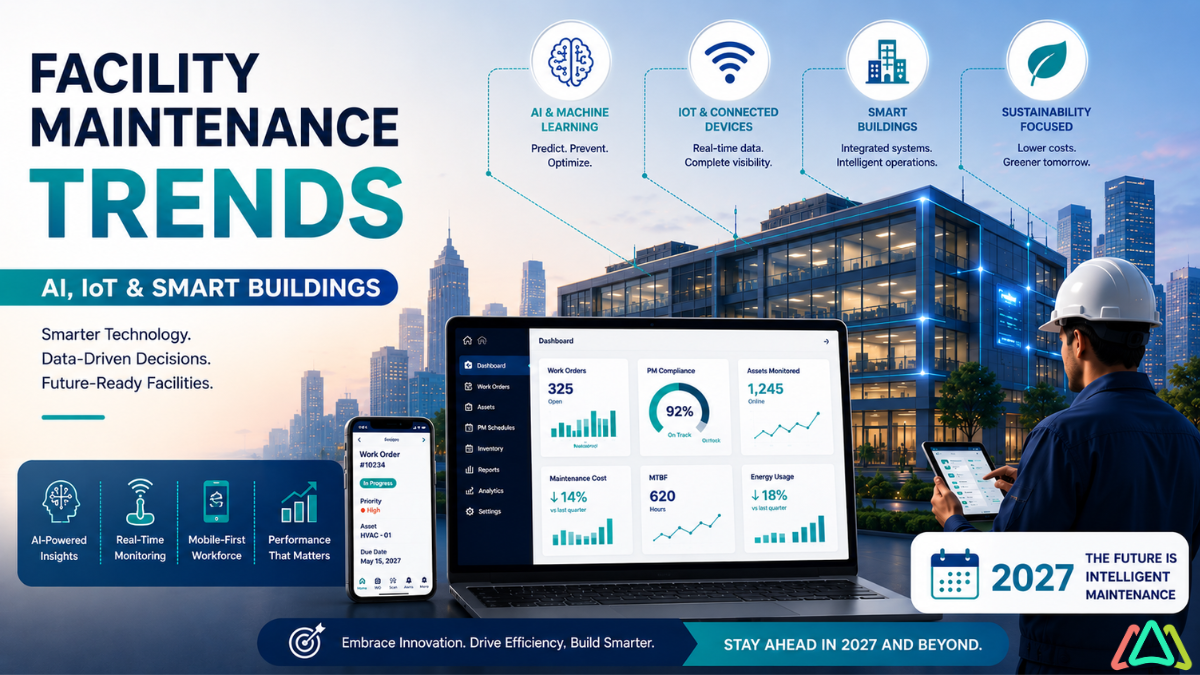
Facility Maintenance Trends for 2027: AI, IoT & Smart Buildings
Introduction
The landscape of facility maintenance is transitioning into a more strategic phase. The biggest maintenance trends shaping 2027 are no longer just about reducing breakdowns or closing work orders faster; they’re about using AI, connected assets, mobile workflows, and data-rich building systems to improve uptime, labor efficiency, energy performance, and risk management. As building systems become more sophisticated, the industry is grappling with growing workloads and limited personnel. IFMA’s FM Pulse Report, based on more than 1,400 responses across 80 countries and 3.2 billion square feet of managed space, found an inaugural Facility Management Workload Index of +43, indicating that more facility professionals expect workload growth in the year ahead. As IFMA’s Nickalos Rocha puts it, “FM leaders face steady workload growth supported by modest budgets and constrained staffing,” and organizations that align planning, sourcing, and risk management early will be best positioned to keep pace and succeed.
That is the real backdrop for the future of facility management. It is not simply digitization for its own sake. It is a response to rising operational pressure, tighter resources, and growing expectations around resilience, sustainability, and occupant experience. Facilities Dive captured the mood well in its 2025 outlook: facility managers are dealing with aging assets, rising prices, and a shrinking workforce, while increasingly turning to AI and automation for efficiency.
AI and Predictive Maintenance
Among the most important maintenance trends for 2027 is the continued rise of predictive maintenance powered by AI. The value proposition is now backed by substantial data. IBM reports that moving from preventive to predictive maintenance can reduce maintenance costs and total downtime by 25% to 30% and by 35% to 45%, respectively. IBM also notes that predictive maintenance solutions can reduce unplanned downtime events by 47% in manufacturing environments and increase technician productivity by 26% in transportation settings.
Deloitte’s findings reinforce that direction. Research indicates that predictive maintenance can reduce maintenance planning time by 20% to 50%, improve equipment uptime and availability by 10% to 20%, and reduce overall maintenance costs by 5% to 10%. Deloitte goes further, calling predictive maintenance the “gold standard” because it helps organizations maximize asset life while minimizing both planned and unplanned downtime. They go on further to explain that this is especially relevant to facility leaders: start with a pilot, build the data and process foundation, then scale fast once the model proves itself.
The deeper implication for AI in maintenance is organizational, not just technical. IBM argues that AI is turning maintenance workers into “data-driven strategists” by helping them identify root causes, preserve institutional knowledge, and act earlier on signals that human observation alone may miss. That expert insight matters because the future of maintenance is not just automated alerts; it is better human decision-making, supported by machine intelligence.
Smart Buildings and IoT
The expansion of smart building infrastructure is another defining force in the future of facility management. Grand View Research estimates the global smart building market reached $141.79 billion in 2025 and projects it will grow to $554.02 billion by 2033, at a CAGR of 18.9% from 2026 to 2033. That level of growth suggests that connected building technologies are moving from optional innovation to core operating infrastructure.
Device growth tells the same story. IoT Analytics projects that the number of connected IoT devices worldwide will have risen 14% year over year to 21.1 billion by the end of 2025, then climb to 39 billion by 2030. Specifically in commercial buildings, Memoori estimates that the installed base of IoT devices is already about 2 billion and will reach 4.12 billion by 2030. Memoori also notes that wireless technologies such as Wi‑Fi and Bluetooth/BLE are expected to represent more than 40% of all connections by 2030, highlighting how distributed sensing and connectivity are becoming the norm in commercial facilities.
For maintenance leaders, these smart building trends point to a major operational shift: buildings are becoming real-time data environments. Grand View Research says advancements in automation, data analytics, and AI-driven energy management are enabling predictive maintenance, real-time monitoring, optimized climate control, and faster-growing support and maintenance services. It also reports that the service segment in smart buildings (including predictive maintenance, commissioning, energy audits, and remote monitoring) is expected to grow at 20.7% CAGR from 2026 to 2033.
The expert takeaway is that value no longer comes solely from sensors. It comes from integration: tying BAS (Building Automation System), BMS (Building Management System), CMMS (Computerized Maintenance Management Software), occupancy, energy, and remote monitoring into a single operating picture that supports smarter prioritization and faster intervention. That is where smart buildings begin to reshape maintenance strategy rather than simply add more dashboards.
Mobile-First Teams
As buildings become smarter, the workforce serving them becomes more mobile. One of the most practical maintenance trends for 2027 is the rise of mobile-first service delivery, a shift away from desktop-based coordination toward in-the-field access to work orders, asset history, SOPs, checklists, and communications.
CBRE’s facilities management trends report describes the rise of the “untethered workforce” and argues that workplace strategies now need to support flexible, human-centered work environments that create “talent advantage.” The report also notes that AI and remote monitoring are helping organizations optimize resource allocation and deliver more adaptive support models. Just as important, 77% of respondents in the report cited cost and value for money as the top driver influencing FM decisions, which helps explain why mobile workflows are gaining traction so quickly.
External workforce data supports the same conclusion. Firstup reports that deskless employees make up more than 80% of the global workforce. In its survey of 1,000 U.S. deskless workers, 51% preferred mobile channels such as text messages or push notifications, while 61% said more timely, relevant updates would improve their performance. Those findings are highly relevant for maintenance operations, where technicians often work across sites, shifts, and asset classes without consistent desktop access.
CBRE adds another useful expert insight: organizations are moving away from purely efficiency-based workplace metrics and toward effectiveness measures such as utilization, employee sentiment, and satisfaction. In a maintenance context, that suggests the next phase of mobile enablement will be judged not just by how fast teams close tickets, but by how well they improve service quality, communication, and workforce retention.
Technician Labor Shortages
Labor scarcity remains one of the strongest drivers behind the future of facility management. According to the U.S. Bureau of Labor Statistics, there will be about 159,800 openings each year, on average, for general maintenance and repair workers over the decade. BLS notes that many of those openings will come from the need to replace workers who exit the labor force or transfer to other occupations, underscoring the dual challenge of talent shortage and knowledge loss.
This is why labor shortages are accelerating interest in AI in maintenance, remote diagnostics, and standardized digital workflows. IFMA’s Michael V. Geary said the FM Pulse findings help organizations avoid being “caught off guard” by supply and staffing issues, scope changes, economic conditions, and regulatory pressures. That is a useful leadership lens: labor constraints are no longer a background issue; they are a strategic planning issue.
The implication for 2027 is clear. Maintenance organizations will need to capture tribal knowledge before experienced workers retire, reduce administrative friction for field teams, and deploy predictive and mobile tools that let smaller teams cover more assets without simply absorbing more reactive work. In that sense, workforce technology is becoming as much a resilience strategy as a productivity strategy.
Sustainability
Sustainability is moving from corporate reporting language into the day-to-day reality of maintenance operations. The 2024/2025 Global Status Report for Buildings and Construction found that buildings and construction account for about 34% of global energy demand and 34% of total energy-related CO2 emissions. It also reported that operational carbon emissions from buildings reached a record 9.8 gigatonnes of CO2 in 2023.
The trend line is concerning. Since 2015, CO2 emissions from building operations have increased by 5.4%, even though the sector needed a 28.1% reduction to stay aligned with climate goals. Global retrofit rates are currently around 1% per year, while the report says 5% to 10% annually is needed. It also notes that about 80% of the building stock that will exist in 2050 is already in place today, which means the performance of existing assets — not just new construction — will determine whether building portfolios decarbonize fast enough.
That makes sustainability one of the most important maintenance trends to watch. Maintenance teams control many of the levers that affect energy use and emissions: calibration, scheduling, controls tuning, asset replacement timing, HVAC performance, leak detection, and equipment runtime. In smart building environments, those decisions can increasingly be supported by AI-driven energy management and remote monitoring, linking the sustainability agenda directly to maintenance execution.
Cybersecurity
Cybersecurity is now inseparable from smart building operations. As more maintenance workflows rely on cloud platforms, connected controls, remote access, and interoperable OT/IT environments, the attack surface for facilities expands.
Siemens highlights the seriousness of that convergence, noting that 50% of cyber attacks originate from OT systems, which is especially relevant for buildings where HVAC, access control, and automation networks interact with enterprise systems. ASHRAE’s expert commentary adds an operational warning: attacks on building automation systems can interfere with occupancy schedules, tenant comfort, facility operations, and even health and safety. In one cited example, a cyberattack on apartment building automation systems in Finland disrupted heating, hot water, and ventilation during winter.
The wider threat picture is also intensifying. The World Economic Forum’s Global Cybersecurity Outlook 2025 reports that 72% of surveyed organizations saw a rise in cyber risks, 71% of chief risk officers expected severe disruption from cyber risks and criminal activity, and 47% of organizations identified adversarial advances powered by generative AI as their primary concern. At the same time, 66% of organizations expect AI to have the greatest impact on cybersecurity in the coming year, but only 37% have processes in place to assess AI security before deployment.
For the future of facility management, the expert insight is straightforward: connected buildings need both “security by design” and “security by operations.” That means secure procurement, segmented networks, OT visibility, continuous monitoring, and tighter collaboration between facilities, IT, and cybersecurity teams. In 2027, cyber resilience will be a maintenance capability, not just an IT policy.
FAQ
What are the biggest facility maintenance trends for 2027?
The most important trends are AI-driven predictive maintenance, expansion of IoT-enabled smart buildings, mobile-first field operations, labor-driven automation, sustainability-focused asset strategies, and cybersecurity for connected building systems.
How is AI changing maintenance?
AI in maintenance is helping teams reduce costs, improve uptime, identify failures earlier, and preserve institutional knowledge. IBM reports 25%–30% lower maintenance costs and 35%–45% lower total downtime from predictive approaches.
Why are smart buildings important for facility teams?
They provide real-time operating data that supports predictive maintenance, optimized climate control, remote monitoring, and more efficient service delivery. Smart buildings turn maintenance from reactive response into data-led performance management.
How are labor shortages affecting the future of facility management?
Shortages are increasing pressure on teams to do more with fewer experienced workers. That is accelerating investments in mobile tools, AI-assisted troubleshooting, digital workflows, and better workforce planning.
Why does sustainability now matter so much to maintenance?
Because buildings account for roughly 34% of global energy demand and 34% of energy-related CO2 emissions, and most of the 2050 building stock already exists today. Maintenance teams directly influence how efficiently those assets perform.
TABLE OF CONTENTS





Keep Reading
Small manufacturing companies across the United States face a common challenge: keeping ...
16 Oct 2026
Choosing the right CMMS software for manufacturing is an important decision for maintenance ...
15 Oct 2026
Facility managers need reliable software to organize maintenance requests, reduce equipment ...
14 Oct 2026
Facility maintenance software and Microsoft Excel both help organizations organize ...
14 Oct 2026
Maintenance teams face growing pressure to reduce equipment downtime, control operating ...
14 Oct 2026
Facility management software helps organizations manage work orders, preventive maintenance, ...
13 Oct 2026
Facility management software in Canada helps organizations manage building maintenance, work ...
12 Oct 2026
For a small maintenance team, CMMS software cost depends on the number of users, features, ...
12 Oct 2026
You should switch maintenance platforms when the current system creates more maintenance ...
12 Oct 2026
Keeping accurate records of equipment maintenance is essential for any organization that ...
5 Oct 2026
Small businesses start managing equipment maintenance with whatever tools are already ...
5 Oct 2026
A maintenance technician is ready to repair a critical piece of equipment, but the ...
2 Oct 2026
Assigning the right work order to the right maintenance technician sounds simple. A ...
2 Oct 2026
A broken door handle gets reported by email. An employee texts a technician about a leaking ...
1 Oct 2026
Even for small maintenance teams, investing in CMMS software is worthwhile when manual ...
1 Oct 2026
Managing a maintenance budget is one of the most important responsibilities for maintenance ...
1 Oct 2026
Managing maintenance across a single school or school district becomes complicated as the ...
29 Sep 2026
Executive Directors are responsible for much more than day-to-day operations. They oversee ...
29 Sep 2026
Managing a maintenance budget is one of the most important responsibilities for maintenance ...
29 Sep 2026
Maintenance Directors should look for CMMS software that makes it easier to manage work ...
28 Sep 2026