Reena Sommer | 28 Aug 2026


Best CMMS for Growing Manufacturers
For growing manufacturers, choosing the right computerized maintenance management system (CMMS) is not simply a software decision. It is a business strategy decision. The right platform can help a plant move from reactive firefighting to more disciplined preventive maintenance, stronger asset tracking, better documentation, and fewer avoidable disruptions.
The challenge is that there is no single CMMS that is best for every manufacturer. A multi-site organization with complex integrations may need something very different from a plant that values fast setup, ease of use, and predictable costs. Food and pharmaceutical manufacturers may prioritize documentation and process control, while heavy-equipment operations may place greater weight on reliability workflows and asset complexity.
For that reason, this guide does not rank six platforms from first to sixth. Instead, it looks at six strong CMMS options and identifies the type of manufacturer each is best suited for. The goal is to help maintenance leaders find the best fit for their operating environment, team, budget, and technology strategy.
The Quick Answer: Best CMMS by Use Case
|
CMMS |
Best suited for |
|
Click Maint |
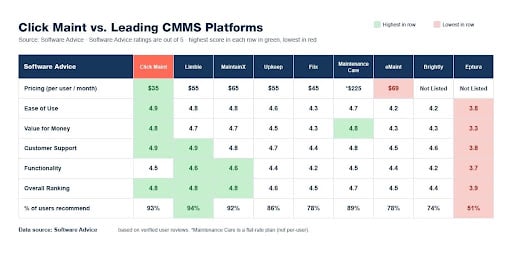
Best overall value and ease of use |
|
eMaint |
Best for heavy equipment and complex maintenance operations |
|
Fiix |
Best for integrations, including IoT, predictive maintenance, and ERP connectivity |
|
MaintainX |
Best for mid-to-large maintenance operations |
|
Limble |
Best for food production and pharmaceutical plants |
|
UpKeep |
Best balance of robust features and ease of use |
How to Compare CMMS Platforms for Manufacturing
Most leading CMMS platforms cover the same core categories: work orders, preventive maintenance, assets, parts, mobile access, and reporting. The more useful question is how well the software fits the way your maintenance team actually works.
- Ease of use and adoption: Can technicians, requesters, and managers use the system consistently without extensive training?
- Preventive maintenance: Can the team build recurring schedules, inspections, checklists, and meter- or condition-based maintenance where needed?
- Asset management: Does the system create a reliable history of repairs, costs, downtime, parts, and maintenance activity?
- Operational complexity: Can the platform support multiple sites, larger teams, specialized workflows, or complex equipment environments?
- Integration requirements: Does maintenance data need to connect with ERP, IoT, condition monitoring, purchasing, or business intelligence systems?
- Industry fit: Are there specific documentation, sanitation, quality, compliance, or audit requirements that matter in your operation?
- Total cost and speed to value: How much effort,
- time, and budget will it take to implement the system and get the team using it effectively?
Click Maint — Best Overall Value and Ease of Use
Click Maint is a strong choice for manufacturers that want a capable CMMS without unnecessary complexity, long implementation cycles, or enterprise-level cost. Its core strength is the combination of usability, practical maintenance functionality, and overall value.
Where Click Maint stands out
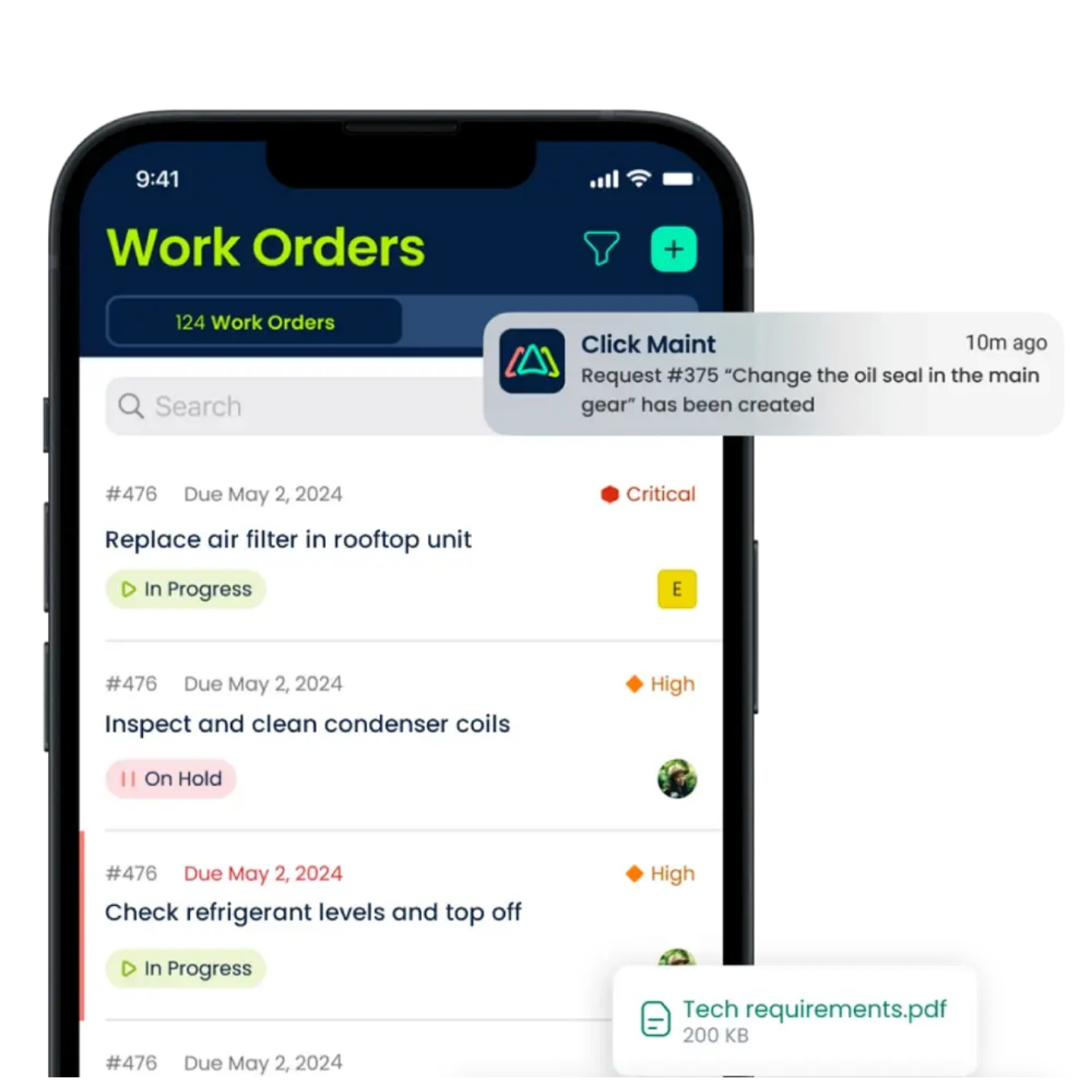
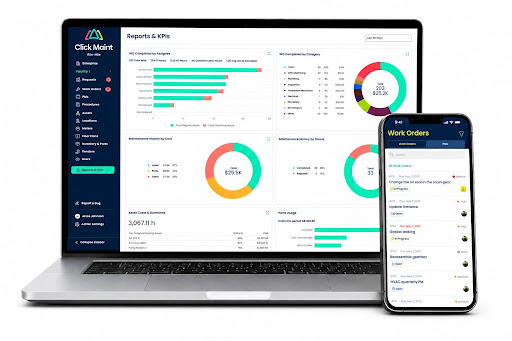
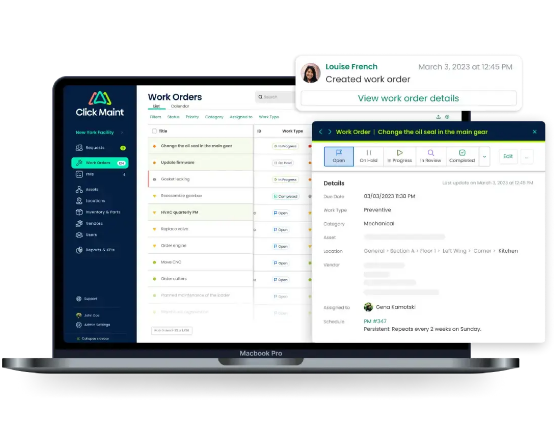
Click Maint brings maintenance requests, work orders, preventive maintenance, inspections, assets, locations, inventory and parts, vendors, costs, QR codes, mobile access, and reporting into one system. That gives growing manufacturers the functionality needed to organize maintenance without forcing technicians and requesters through a complicated user experience.
Ease of use matters because CMMS value depends on adoption. If technicians do not update work orders, requesters avoid the system, or managers still rely on spreadsheets outside the platform, the software never becomes a trustworthy source of maintenance information. Click Maint is designed to reduce that friction and help teams get up and running quickly.
It is also well suited to manufacturers that want strong value from their CMMS investment. For a growing plant, avoiding unnecessary implementation complexity can be just as important as subscription price. Faster onboarding, simpler workflows, and broad functionality can help the organization reach value sooner while still supporting preventive maintenance, asset history, parts tracking, and performance reporting.
For manufacturers with multiple facilities, Click Maint can also provide centralized visibility without making each location feel like a separate system. This can be especially useful for organizations that are expanding and want consistency across sites while keeping the day-to-day experience simple for local teams.
Click Maint CMMS is best for:
Manufacturers that prioritize ease of use, fast adoption, broad CMMS functionality, and strong overall value. It is particularly attractive for small and mid-sized manufacturers, growing multi-site organizations, and teams replacing spreadsheets, paper, or an overly complex legacy CMMS.
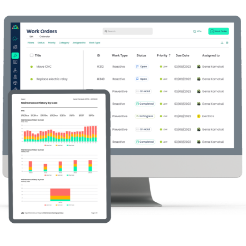
See Click Maint CMMS for Manufacturers in Action
See how easy it is to manage work orders, maintenance requests, and preventive maintenance with Click Maint CMMS for manufacturers. Take the quick 2-minute interactive product tour.
eMaint — Best for Heavy Equipment and Complex Maintenance Operations
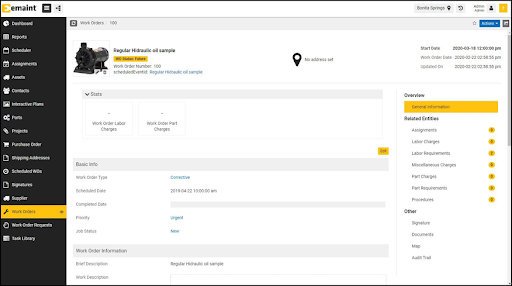
eMaint is well suited to asset-intensive environments where maintenance programs involve complex equipment, reliability initiatives, condition monitoring, and detailed workflows. Its depth can be valuable when maintenance is closely tied to plant reliability and the cost of equipment failure is high.
Where eMaint stands out
The platform supports digital work orders, asset management, preventive maintenance calendaring, condition monitoring, dashboards, and more structured maintenance workflows. For organizations managing large or critical equipment fleets, that depth can help teams move beyond basic task tracking toward a more formal reliability program.
eMaint can also appeal to operations where maintenance information needs to be documented in detail across assets, work history, inspections, and condition data. That makes it a strong candidate for larger or more technically complex plants where maintenance maturity is already relatively high.
eMaint is best for:
Heavy-equipment manufacturers, asset-intensive plants, and maintenance organizations that need deeper reliability workflows, condition monitoring, and support for more complex maintenance programs.
Fiix — Best for Integrations, IoT, PdM, and ERP Connectivity
Fiix is a strong option for manufacturers that view the CMMS as part of a broader connected technology environment. Its appeal is especially clear when maintenance data needs to integrate with ERP systems, production technology, condition monitoring, or other operational platforms.
Where Fiix stands out
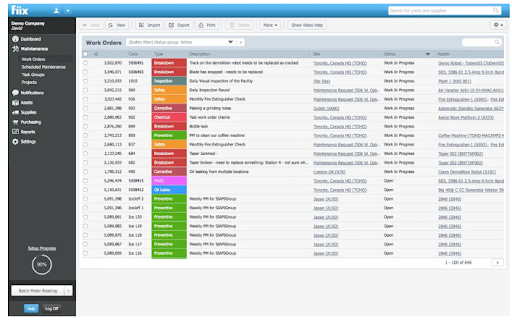
Fiix centralizes work orders, preventive maintenance, equipment information, and asset history while placing significant emphasis on system connectivity. For digitally mature manufacturers, this can matter because maintenance rarely operates in isolation. Purchasing, production, IoT sensors, predictive maintenance tools, and enterprise reporting may all need to exchange information with the CMMS.
This integration orientation gives Fiix a strong use case for manufacturers building toward more connected maintenance operations. A plant may begin with traditional preventive maintenance and later expand into sensor-driven condition monitoring, predictive maintenance, or tighter ERP integration.
Fiix is best for:
Manufacturers with strong integration requirements, including organizations connecting maintenance with IoT, predictive maintenance, ERP, production, or enterprise data systems.
MaintainX — Best for Mid-to-Large Maintenance Operations
MaintainX is a strong fit for maintenance organizations that need to coordinate a larger volume of work across technicians, supervisors, assets, and locations. Its focus on mobile execution, standardized procedures, recurring maintenance, and operational communication makes it well suited to teams with more moving parts.
Where MaintainX stands out
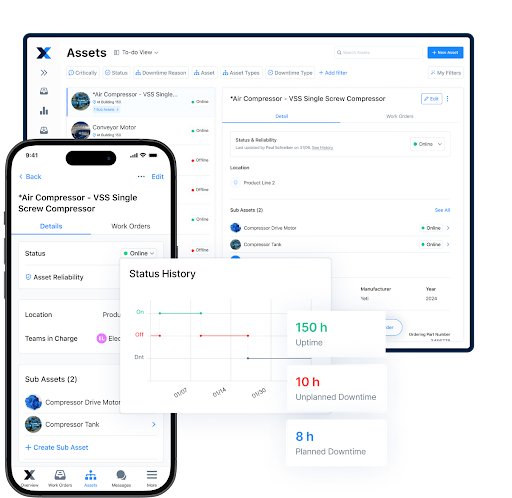
MaintainX emphasizes recurring preventive maintenance, condition- and meter-based triggers, mobile work execution, required fields, digital audit trails, and asset-level maintenance history. Those capabilities can be especially useful as a maintenance department grows and managers need greater consistency in how work is assigned, completed, documented, and reviewed.
For mid-to-large operations, the challenge is often not simply creating work orders. It is maintaining process discipline across shifts, facilities, supervisors, and technicians. A platform that supports structured procedures and real-time mobile execution can help standardize that work at scale.
MaintainX is best for:
Mid-to-large maintenance organizations, multi-team operations, and manufacturers that need strong mobile execution, standardized procedures, and structured maintenance workflows across a larger workforce. MaintainX has invested a lot in AI capabilities. This is relatively new and will be interesting to see how their AI tools help maintenance teams.
Limble — Best for Food Production and Pharmaceutical Plants
Limble is a strong choice for manufacturing environments where equipment uptime must be paired with consistent documentation, inspections, preventive maintenance, and clear operational visibility. That combination is particularly relevant in food production and pharmaceutical plants, where maintenance often intersects with quality, sanitation, and audit readiness.
Where Limble stands out
Limble emphasizes preventive maintenance scheduling, maintenance calendars, asset histories, spare-parts inventory, work request portals, QR codes, dashboards, and reporting. Its usability and visibility can help teams create repeatable maintenance processes without making the system unnecessarily difficult to use.
In regulated or process-sensitive environments, consistency matters. Maintenance teams need to know that scheduled work was completed, inspections were documented, equipment history is accessible, and recurring issues can be identified quickly. Limble also meets high compliance standards like 21 CFR Part 11, which is common in pharmaceutical and food and beverage processing plants. Limble’s combination of workflow structure and accessible reporting can make it a practical fit for these settings.
Limble is best for:
Food production, beverage, pharmaceutical, and other process-driven manufacturing environments that value preventive maintenance discipline, documentation, visibility, and straightforward execution. It’s an ideal choice for manufacturers that must adhere to very strict compliance standards.
UpKeep — Best Balance of Robust Features and Ease of Use
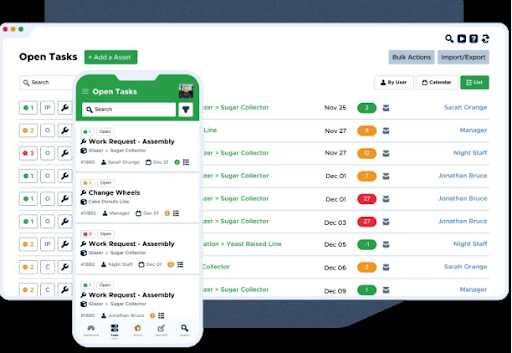
UpKeep is a strong middle-ground option for manufacturers that want a broad CMMS feature set without giving up usability. Its mobile-first approach makes it particularly relevant for technicians who spend most of their time on the floor rather than at a desk.
Where UpKeep stands out
UpKeep supports work orders, preventive maintenance, asset visibility, usage-based scheduling, real-time updates, photos, checklists, and mobile work capture. That combination helps maintenance teams manage a fairly robust operation while keeping day-to-day execution accessible for technicians.
The balance is the key differentiator. Some manufacturers want more than a lightweight work-order tool but do not need the complexity of a highly specialized enterprise maintenance platform. UpKeep can fit well in that middle ground, especially where mobile adoption is a priority. Upkeep has also developed a lot of new AI capabilities. These are very new and will be exciting to see how they impact maintenance teams.
Upkeep is best for:
Manufacturers that want a solid range of CMMS capabilities with a user-friendly, mobile-oriented experience and a practical balance between feature depth and ease of use.
Which CMMS Is the Best Fit for Your Manufacturing Operation?
The right choice depends on what your maintenance team values most. If ease of use, fast adoption, and overall value are top priorities, Click Maint deserves serious consideration. If your environment is dominated by heavy equipment and advanced maintenance complexity, eMaint may be the better fit. If integrations and connected maintenance are central to your strategy, Fiix stands out. MaintainX is well suited to larger maintenance organizations that need structured execution at scale. Limble is compelling for food production and pharmaceutical environments, while UpKeep offers a strong balance between capability and usability.
The most important point is to avoid choosing software based only on the longest feature list. A CMMS creates value when the team actually uses it, the implementation fits the organization, and the system improves how preventive maintenance, work orders, assets, and maintenance data are managed every day.
What Growing Manufacturers Should Prioritize in 2026
1. Adoption should be treated as a core requirement
Technicians, supervisors, and requesters need to use the system consistently. A powerful CMMS that is difficult to navigate can create more administrative work and push teams back toward spreadsheets, text messages, or paper.
2. Preventive maintenance must be easy to build and execute
Recurring schedules, inspections, checklists, meter readings, and mobile completion should support the maintenance program rather than slow it down. The easier it is to create and complete PM work correctly, the more likely the program is to remain consistent.
3. Asset history should support better decisions
A useful CMMS should help answer practical questions: What failed? What was done? How often is it happening? What did it cost? Which parts were used? How much downtime was involved? That history is what turns maintenance data into better planning.
4. Integration depth should match the operation
Not every plant needs extensive integrations on day one. Some do. Manufacturers should decide whether they need a straightforward standalone CMMS, connections to ERP and business intelligence systems, or a more advanced environment involving IoT and predictive maintenance.
5. Total cost should include implementation and administration
Subscription price is only part of the cost. Training, implementation effort, configuration, ongoing administration, and user adoption all affect the real return on investment. A system that is faster to deploy and easier to maintain may deliver more value even if another platform has a longer feature list.
Final Verdict
There is no universal number-one CMMS for every growing manufacturer. The better approach is to identify the platform that best matches the organization’s priorities.
- Look at Click Maint for the best overall combination of value, ease of use, fast adoption, and practical CMMS capability.
- Look at eMaint for heavy equipment and complex, reliability-focused maintenance operations.
- Consider Fiix when integrations, IoT, predictive maintenance, and ERP connectivity are central requirements.
- Consider MaintainX for mid-to-large maintenance organizations that need structured execution across larger teams.
- Limble should be considered for food production and pharmaceutical environments where preventive maintenance, documentation, and operational visibility are especially important.
- UpKeep is a great option for manufacturers looking for a strong balance of robust CMMS functionality and ease of use, particularly for mobile maintenance teams.
For many growing manufacturers, the best CMMS will not be the platform with the most complexity. It will be the one that can be implemented successfully, adopted consistently, and used to improve maintenance performance every day.
Frequently Asked Questions
What is the best CMMS for a growing manufacturer?
There is no single best platform for every manufacturer. Click Maint is a strong overall choice for organizations prioritizing value and ease of use, while other platforms may be better suited to specific needs such as heavy equipment, integrations, large maintenance teams, regulated production, or mobile-first execution.
What should manufacturers look for in CMMS software?
Manufacturers should evaluate preventive maintenance, asset tracking, mobile usability, reporting, parts and inventory, implementation requirements, integrations, scalability, and total cost. Just as important, they should consider whether technicians and requesters will actually use the system consistently.
Can CMMS software help reduce downtime?
Yes. A CMMS can support downtime reduction by improving preventive maintenance execution, preserving asset history, identifying recurring failures, organizing work priorities, and helping managers act on better maintenance data. The software itself is not a substitute for maintenance discipline, but it can make that discipline easier to sustain.
Which CMMS is best for manufacturers that want easy implementation and strong value?
Click Maint is designed for organizations that want broad maintenance functionality with an emphasis on ease of use, quick onboarding, and value. It can be especially attractive to manufacturers replacing manual processes or overly complex legacy systems.
Which CMMS is best for integrations?
Fiix is a strong option for manufacturers that need the CMMS to connect with ERP, IoT, predictive maintenance, and other operational systems. But most CMMS have API and webhooks needed for integrations , so don’t rule them all out. See Click Maint API.
Does mobile access matter in manufacturing maintenance?
Yes. Maintenance work happens on the floor, so technicians benefit from being able to view assignments, update work orders, add photos, complete checklists, and document work from a phone or tablet without returning to a desktop computer.
TABLE OF CONTENTS