Reena Sommer | 15 Oct 2026


Choosing the right CMMS software for manufacturing is an important decision for maintenance managers, plant managers, and operations directors. Manufacturing facilities depend on reliable equipment, efficient maintenance schedules, and organized work orders to maintain production and control operating costs.
An effective computerized maintenance management system (CMMS) helps manufacturing teams organize maintenance activities, track equipment performance, schedule preventive maintenance, and manage spare parts inventory.
However, not every CMMS offers the same features, usability, or value. Some systems are designed for large enterprises with complex operations and requirements, while others focus on affordability, ease of use, and essential maintenance management functions.
This guide explains how to choose CMMS software for manufacturing, what features to evaluate, which questions to ask vendors, and how to select a solution that fits your facility's needs and budget.
What Is CMMS Software for Manufacturing?
CMMS software for manufacturing is a digital maintenance management system that helps factories and production facilities manage work orders, equipment assets, preventive maintenance, spare parts inventory, and maintenance records in one centralized platform.
Manufacturing maintenance teams use CMMS software to replace spreadsheets, paper work orders, and disconnected maintenance tracking systems.
A CMMS for manufacturing plants provides maintenance managers with greater visibility into equipment conditions, maintenance schedules, technician assignments, and maintenance costs.

For example, a production facility operating multiple machines uses CMMS software to schedule routine inspections, assign repair work orders, and maintain equipment service histories. Instead of searching through spreadsheets or paper records, technicians access maintenance information through a centralized system.
Why Is Choosing the Right CMMS Important for Manufacturing Companies?
Manufacturing facilities operate in environments where equipment reliability directly affects productivity, operating costs, and production schedules. Unplanned equipment failures interrupt production, delay orders, and increase maintenance expenses.
Selecting the right manufacturing maintenance software helps organizations improve several important areas:
- Equipment reliability: Track equipment maintenance histories and identify recurring failures.
- Preventive maintenance: Schedule inspections, lubrication, servicing, and routine maintenance.
- Work order management: Assign, prioritize, and track maintenance tasks.
- Maintenance costs: Monitor labor, spare parts, and equipment repair expenses.
- Inventory management: Track spare parts availability and reduce unnecessary purchases.
- Maintenance visibility: Give plant managers and maintenance supervisors access to maintenance performance data.
- Team productivity: Help technicians access maintenance tasks and equipment information through mobile devices.
For small and mid-sized manufacturers, choosing an affordable and easy-to-use CMMS is especially important. Complicated software creates unnecessary administrative work and reduces employee adoption.
Manufacturing CMMS Software Buyer's Checklist: 12 Features to Evaluate
Before investing in manufacturing CMMS software, maintenance managers should evaluate the following essential capabilities.
Interactive CMMS evaluation checklist
0 of 12 reviewed
1. Work order management
Create, assign, prioritize, and track maintenance work orders.
2. Preventive maintenance scheduling
Schedule recurring maintenance by time or supported meter readings.
3. Equipment and asset management
Maintain asset records, repair histories, and equipment details.
4. Spare parts inventory management
Track inventory quantities, parts usage, and reorder needs.
5. Mobile maintenance access
Give technicians access to work orders and asset information in the field.
6. QR code scanning
Provide fast access to equipment records and maintenance tasks.
7. Maintenance request portal
Allow authorized employees to submit and track maintenance requests.
8. Reporting and maintenance KPIs
Track downtime, maintenance costs, work orders, and other key metrics.
9. Ease of use and onboarding
Confirm technicians and supervisors can learn the software quickly.
10. Affordability and total cost
Compare subscriptions, setup fees, support, and future costs.
11. Integrations and data migration
Review compatibility with existing systems and historical maintenance data.
12. Security, support, and scalability
Evaluate access controls, vendor support, and future growth requirements.
Reset checklist Copy checklist
1. Work Order Management
Work order management is one of the most important features of manufacturing CMMS software. Manufacturing maintenance teams handle equipment repairs, inspections, emergency maintenance, and routine servicing. Without a centralized system, maintenance requests become difficult to prioritize and track.
Look for CMMS software that supports work order creation, technician assignments, priority levels, due dates, status updates, and maintenance history.
Questions to ask vendors:
- How quickly does a technician create or update a work order?
- Does the software support work order priorities and assignments?
- Does it track labor hours, parts usage, and completed maintenance tasks?
- Does it provide mobile access for technicians?
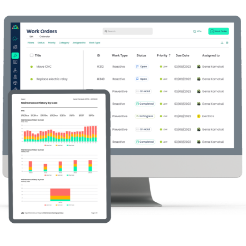
Click Maint offers work order management tools designed to help maintenance teams organize and track daily maintenance activities.
2. Preventive Maintenance Scheduling
Preventive maintenance is essential for manufacturing facilities that depend on reliable production equipment. A CMMS should help maintenance managers schedule recurring inspections, equipment servicing, lubrication, filter replacements, and other preventive maintenance tasks.
Evaluate whether the software supports calendar-based maintenance, recurring work orders, maintenance checklists, and maintenance notifications. If your plant needs meter-based scheduling, confirm support for runtime or production-cycle triggers during the demonstration.
An organized preventive maintenance program helps reduce missed inspections and supports equipment reliability.
3. Equipment and Asset Management
Manufacturing plants operate machinery, production lines, compressors, conveyors, forklifts, HVAC equipment, and other critical assets. A manufacturing CMMS should maintain organized equipment records that include asset identification, location, maintenance history, repair records, and associated work orders.
Ask whether the software supports asset hierarchies, document attachments, equipment categories, and asset-specific maintenance reporting.
A centralized equipment history helps maintenance managers make better repair, replacement, and maintenance planning decisions.
4. Spare Parts Inventory Management
Missing spare parts delay equipment repairs and extend downtime. Manufacturing CMMS software should help maintenance teams track spare parts quantities, storage locations, usage history, and inventory requirements.
Important capabilities include inventory tracking, parts assignments to work orders, reorder alerts, and inventory reports. For manufacturing plants with multiple storerooms, verify whether the software supports inventory across different locations.
5. Mobile CMMS Software for Maintenance Technicians
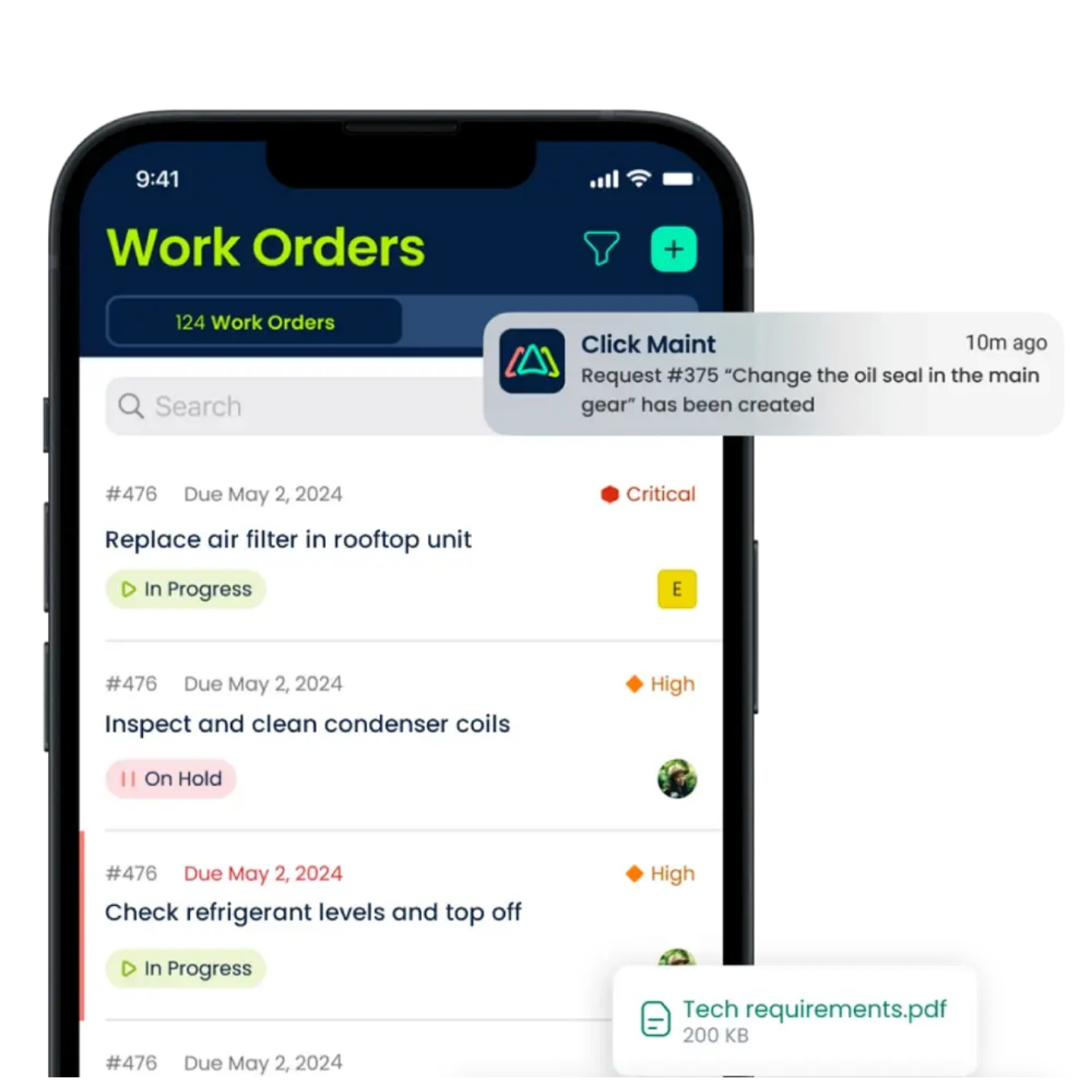
Maintenance technicians spend much of their time on production floors, in equipment rooms, and around manufacturing facilities. Mobile CMMS access helps technicians review assigned tasks, update work order statuses, access equipment records, and document completed repairs without returning to an office computer.
During vendor demonstrations, test the mobile experience on the devices your technicians use. Also confirm offline functionality if your facility has limited wireless connectivity.
6. QR Code Scanning for Equipment Maintenance
QR code scanning helps maintenance technicians identify equipment and access related information. For example, a technician scans a QR code attached to a production machine to locate its equipment record and associated maintenance information. Evaluate how quickly the CMMS opens asset details and whether technicians can initiate or update maintenance tasks through the mobile workflow.

Click Maint includes mobile maintenance capabilities with QR code scanning to support equipment identification and maintenance tracking.
7. Maintenance Request Portal
Manufacturing maintenance requests originate from machine operators, production supervisors, safety personnel, and other employees. A maintenance request portal provides a structured process for submitting equipment problems and repair requests.
Look for a system that allows authorized employees to submit maintenance requests, describe equipment problems, select locations, and follow request progress. A centralized request process reduces dependence on phone calls, text messages, emails, and paper forms.
8. Maintenance Reporting and KPIs
Maintenance managers need accurate information to evaluate equipment reliability, work order performance, and maintenance expenses.
Look for CMMS reporting tools that support metrics such as:
|
Maintenance KPI |
What it measures |
|
Mean Time to Repair (MTTR) |
Average repair duration |
|
Mean Time Between Failures (MTBF) |
Average operating time between repairable failures |
|
Preventive Maintenance Compliance |
Percentage of scheduled PM work completed within the defined timeframe |
|
Work Order Backlog |
Outstanding maintenance work |
|
Maintenance Cost by Asset |
Labor and parts costs associated with individual equipment |
|
Planned vs. Unplanned Maintenance |
Distribution of scheduled and reactive maintenance work |
Ask vendors how these metrics are calculated and which reports are included in the subscription.
9. Ease of Use and Employee Adoption
Even feature-rich maintenance management software provides limited value when technicians find it difficult to use. Manufacturing maintenance teams need a system that supports daily operations without complicated navigation or excessive data entry.
During a software demonstration, ask a maintenance technician to complete common tasks such as opening a work order, updating equipment information, and recording completed maintenance. An intuitive interface reduces training requirements and helps encourage consistent software adoption.
10. Affordable CMMS Pricing and Total Cost
Manufacturing companies should compare more than the advertised monthly subscription price.
Evaluate the total cost of ownership, including software subscriptions, implementation, data migration, onboarding, technical support, additional users, and optional integrations. A lower subscription price does not automatically mean better value. The right CMMS should provide the features your manufacturing facility needs without unnecessary complexity or unexpected costs.

Click Maint is positioned as an affordable, easy-to-use CMMS solution for organizations seeking essential maintenance management functionality.
11. Integration and Data Migration
Many manufacturing facilities already use ERP systems, accounting software, inventory applications, or production management tools.
Before choosing a CMMS, identify which systems need to exchange information. Ask vendors about available integrations, API access, import and export options, and data migration services. For manufacturers replacing spreadsheets, confirm how equipment records, maintenance histories, and parts inventory information will be transferred.
12. Security, Vendor Support, and Scalability
Manufacturing maintenance software should support the organization's security policies and operational growth.
Evaluate user permissions, data protection practices, support availability, backup procedures, and software reliability. Also consider whether the CMMS supports additional equipment, users, departments, or facilities as the manufacturing business expands.
Request documentation for any required security certifications, service commitments, or compliance controls rather than assuming every vendor provides them.
How to Compare CMMS Software Vendors for Manufacturing
A structured evaluation process helps manufacturing decision-makers compare vendors using consistent criteria. The following weighted scorecard is an example. Adjust the percentages to match your plant's priorities.
|
Evaluation criterion |
Suggested weight |
|
Work order and preventive maintenance |
25% |
|
Equipment and inventory management |
20% |
|
Ease of use and mobile access |
20% |
|
Pricing and total cost |
15% |
|
Reporting and maintenance visibility |
10% |
|
Support, security, and integrations |
10% |
|
Total |
100% |
Rate each vendor from 1 to 5 in every category and calculate a weighted score.
Manufacturers with complex production environments should place additional emphasis on integration requirements, asset hierarchies, reliability analytics, and implementation capabilities.
How Much Does CMMS Software Cost for Manufacturing?
Manufacturing CMMS pricing depends on the number of users, required functionality, implementation services, and subscription plan.
Click Maint's manufacturing page currently lists its Professional Plan at $35 USD per user per month. Confirm current billing terms and inclusions before purchasing.
For example, at this listed rate:
|
Number of users |
Monthly subscription |
Annual subscription |
|
5 |
$175 |
$2,100 |
|
10 |
$350 |
$4,200 |
|
20 |
$700 |
$8,400 |
These calculations exclude implementation fees, taxes, optional services, and other charges. When evaluating affordability, compare the cost against technician productivity, equipment downtime, maintenance administration, and parts inventory management.
Manufacturing CMMS Case Study: TS Manufacturing
A practical example of CMMS adoption comes from TS Manufacturing, a Canadian manufacturer based in Lindsay, Ontario.
Before adopting Click Maint, TS Manufacturing relied on paper binders, handwritten maintenance records, and manual preventive maintenance tracking.
This created difficulties with finding previous equipment repairs, sharing maintenance knowledge, and confirming completed preventive maintenance.
TS Manufacturing selected Click Maint to introduce a more organized maintenance management process and centralize important equipment information.
The example demonstrates why manufacturers replacing paper-based systems should prioritize accessible equipment histories, preventive maintenance tracking, and ease of adoption.
Read the TS Manufacturing CMMS case study.
Why Consider Click Maint for Manufacturing Maintenance?
Click Maint is designed to provide practical maintenance management functionality with an emphasis on affordability and ease of use.
Manufacturing teams evaluating Click Maint should consider its capabilities for work order management, preventive maintenance scheduling, equipment history, parts inventory, maintenance requests, and mobile access.
Its mobile app includes QR code workflows that help technicians access asset information and create maintenance work orders directly from equipment labels.
For manufacturers that need an easy-to-use CMMS rather than an extensive enterprise asset management platform, Click Maint is a strong candidate to evaluate. Manufacturers requiring advanced predictive analytics, specialized automation, or extensive ERP integrations should verify those requirements during the buying process.
Frequently Asked Questions About Manufacturing CMMS Software
What is the best CMMS software for manufacturing?
The best CMMS software depends on the manufacturing facility's equipment, maintenance processes, budget, and integration requirements. Click Maint is an option worth evaluating for manufacturers prioritizing affordability, usability, preventive maintenance, and work order management.
What features should manufacturing CMMS software include?
Essential features include work order management, preventive maintenance scheduling, equipment tracking, spare parts inventory, mobile access, maintenance history, and reporting.
Is CMMS software worth it for small manufacturing companies?
Yes, when the benefits justify the subscription and implementation costs. Small manufacturers using spreadsheets, paper records, or disconnected systems have opportunities to improve maintenance organization and reduce administrative work.
How does manufacturing CMMS software reduce equipment downtime?
CMMS software supports downtime reduction by organizing preventive maintenance, tracking equipment problems, maintaining repair histories, and improving work order response. Actual results depend on maintenance practices, equipment conditions, and software adoption.
How long does it take to implement manufacturing CMMS software?
Implementation time depends on the number of assets, maintenance records, users, required integrations, and training needs. Manufacturers should request a project timeline from each vendor.
What is the difference between manufacturing CMMS and ERP software?
CMMS software focuses on equipment maintenance, work orders, preventive maintenance, and asset histories. ERP software manages broader business processes such as finance, purchasing, production planning, and supply chain operations.
Final Thoughts: Choosing the Right Manufacturing CMMS
Selecting the right CMMS software for manufacturing requires more than comparing feature lists.
Manufacturing maintenance managers should evaluate how the system supports daily work orders, preventive maintenance, equipment reliability, spare parts management, and maintenance reporting.
The most valuable CMMS is one that meets the facility's operational requirements, fits the budget, and is consistently used by maintenance employees.
Click Maint brings essential maintenance management capabilities into an affordable, easy-to-use platform for manufacturing maintenance teams.
Ready to Find the Right CMMS for Your Manufacturing Facility?
See how Click Maint helps manufacturing maintenance teams organize work orders, preventive maintenance, equipment assets, and spare parts inventory.
TABLE OF CONTENTS